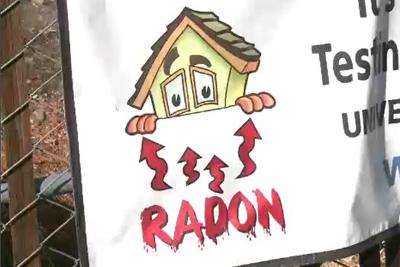
January is National Radon Action Month, and it's a good time to know how to protect your family and home from potential gas leaks. At the University of Nevada Cooperative Extension office, radon program director Susan Howe told us, "Radon is a radioactive gas that occurs naturally, and you can't sense it in any way. It can get into your house."
It’s an odorless, colorless, tasteless, and chemically-inert gas that's formed by the radioactive decay of uranium deposits in the ground. Howe has been ringing the “radon alarm” for 20 years now. To her, its serious business…an often unknown and too-often undetected silent killer. As she told us, "Radon is a primary cause of lung cancer for non-smokers, and the second-leading cause of cancer in smokers."
It's so dangerous, about 21,000 Americans die each year from radon-caused lung cancer. The gas gets in through cracks in the foundation, walls and floors...gaps around pipes and even through well water. Winter is an ideal time for you to test for this ubiquitous danger. UNR’s Radon Education Coordinator Nadia Noel told us, "Winter's the time when the radon can accumulate, because there's no way for it to get out easily because we're not circulating the air as much in our homes."
The free test they offer is just a little bit of charcoal in a container. You leave it open in your house for 3 days and send it to the lab address on the box. They measure radioactivity by what's called 'picocuries.' The average radon rating in the U.S. is 1.3 picocuries, but in Washoe County...it's 3.4. Noel says in some areas around town it’s even higher: "In Washoe Valley or Verdi, their percentages of homes are definitely higher...it's up to 48%."
It's a big number, and alarming, but while you can't see or smell radon, there are ways you can protect yourself from it. As Howe told us, "The good news is that homes with radon problems can be fixed. A radon mitigation system can be installed."
Noel says it’s really quite simple: "A fan system where there's piping involved, and the piping goes to the very foundation of the home, where it’s used to suck out all the radon out of the house."
Your first step is to get the test. It's free. After three days you just send it to the lab. Noel says, "They do their analysis of it. They determine what the level is in your home, and so that's technically how it works. It's pretty simple."
You can pick up your free radon test kit at the Cooperative Extension office now through February 28th, at 4955 Energy Way in Reno:
http://www.unce.unr.edu/programs/sites/radon/testing/#testkit
You can also see what level your area has online, by checking the Cooperative Extension’s radon map. To check that, click the link below: