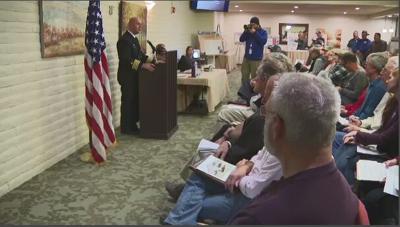
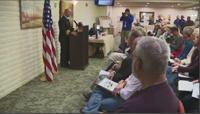
On Thursday the Navy held the seventh and last in a series of public meetings about modernizing the training facilities at NAS Fallon and the results contained in a Draft Environmental Impact Statement. It's an issue that involves hundreds of thousands of acres of public land.
All naval aviators have to go through NAS Fallon before being deployed. The bombing ranges there haven't changed much since the 1990's and the Navy says current technology is outpacing the capabilities there.
"Although the weapons are more accurate because our tactics have us releasing the weapons further away form the target, the potential - if the weapon doesn't work right - is a larger area," said Alex Stone, Navy Project Manager for the EIS. "That's the area we need to control due to safety."
Their plan is to upgrade infrastructure and expand the range - for the most part, with public lands.
"It's roughly 600,000 acres of public land and 65,000 of private land," Stone said.
Some residents that spoke during public comment voiced concerns about the sheer amount of land that could be taken, along with access and recreation issues.
The Fallon National Wildlife Refuge is big concern for the nonprofit group Friends of Nevada Wilderness.
"We don't think refugees should be turned into bombing ranges," said Shaaron Netherton, the group's Executive Director. "That refuge was established in 1931 to protect wildlife and we think it should stay that way."
The Dixie Valley area is another parcel they're worried about.
"That area has been protected since the late 1970's for the wilderness qualities there," Netherton said. "So getting rid of some of those lands for military operations would be a travesty for our recreation, our wildlife. We want to keep those as wilderness study areas but we are also very pragmatic and happy to work with the military on finding a win-win solution. National defense is very important but protecting our wilderness-quality lands is also very important."
The Navy says modernizing these ranges is critical to its mission.
"It's really critical; our mission is to make sure our Navy is prepared and the training we give them is really adequate is really realistic to what were going to face in combat," Stone said. "Fallon is where we train Naval Aviators there is no other place where we do what we do at Fallon in the Navy so this modernization is critical to the Navy."