As wildfire concerns continue to shape life around Lake Tahoe, new fire safety rules are now on the calendar for Incline Village and Crystal Bay.
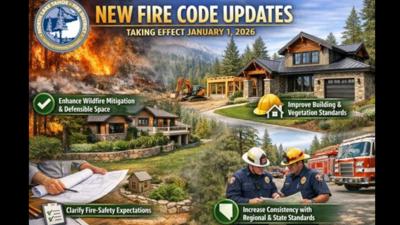
The North Lake Tahoe Fire Protection District says the newly adopted 2024 Lake Tahoe Nevada Fire Code and 2024 Lake Tahoe Nevada Wildland Urban Interface Code will take effect January 1, 2026.
The updates are based on the 2024 International Fire Code and the 2024 International Wildland Urban Interface Code, with local changes meant to reflect Tahoe Basin wildfire risks and environmental conditions.
District officials say the goal is to strengthen safety while making expectations clearer for people planning projects or caring for property.
The updated codes are designed to enhance wildfire mitigation and defensible space standards, improve building and vegetation requirements in high risk areas, clarify fire safety expectations for new construction, remodeling, and existing properties, and better align local rules with regional and state practices.
“These updates reflect our commitment to reducing wildfire risk while ensuring clear, modern, and locally appropriate safety standards for our community,” Fire Chief Ryan Sommers said. “With wildfire threats continuing to evolve, these codes provide essential tools to protect lives, property, and our natural environment.”
The rules apply to new construction, permitted projects, and certain maintenance requirements starting in 2026.
The district is encouraging homes, builders, architects, and property managers to review the changes well before they take effect to allow time for planning and compliance.
Educational materials, summaries of key updates, and full code documents are available through the North Lake Tahoe Fire Protection District website.
“For the NLTFPD, prevention has never been optional,” Fire Marshal John James said. “With the adoption of the updated Lake Tahoe Nevada Fire Code and Wildland–Urban Interface (WUI) Code, in alignment with Tahoe Douglas Fire, we are enhancing safety and resilience across our community, for both people and the environment. NLTFPD has led this work for decades—defensible space since 1985, fuels management and prescribed fire since 1995, and WUI enforcement since 2013. These updates simplify compliance and provide clear, consistent standards for anyone designing or working on the Nevada side of the Tahoe Basin.”
More information, including the full codes and guidance, can be found on the district’s website.