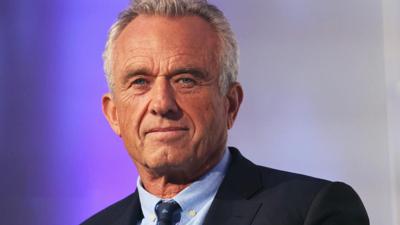

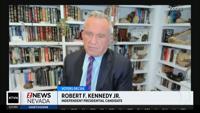

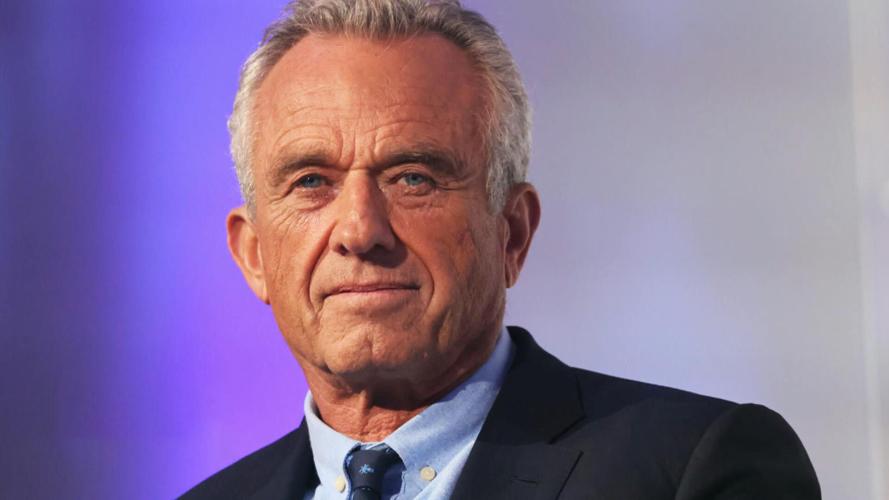
The Robert F. Kennedy Jr. and Nicole Shanahan ticket will officially appear on the presidential ballot in Nevada.
Campaign leaders will submit the final legal documentation -- Declaration of Candidacy, Elector List and Elector Pledges -- to the Nevada Secretary of State's office in Las Vegas on Monday afternoon at approximately 1 p.m.
In Nevada, the campaign gathered 30,000 signatures. The campaign says a large portion of those signatures came immediately after the presidential debate.
As of last Wednesday, the campaign has gathered sufficient signatures to get on the ballot in 42 states, enough to secure 480 electoral college points, which is more than the 270 needed to win.
In doing so, they have amassed more than 100,000 volunteers nationwide and gathered 1 million signatures, surpassing any candidate in American history.
"They forced us to bear this expense and to organize this tremendous effort. It has put us at a huge advantage in the upcoming election because we now have a hundred thousand highly motivated, proven, and battle-tested volunteers. Who are on the street, and we are now deploying them," said Independent Presidential candidate Robert F. Kennedy Jr.
Robert F. Kennedy Jr.'s campaign has encountered bureaucratic and legal obstacles in getting on the ballot in Nevada, a situation that has been consistent for the campaign across all 50 states and the District of Columbia.
The campaign submitted over 15,000 signatures to the state in January. However, in early March, the secretary of state's office informed them that their petition was invalidated due to inaccurate guidance provided by an office staffer.
The Nevada State Democratic Party is currently involved in a lawsuit against both the campaign and the Nevada Secretary of State to prevent Kennedy from being listed on the ballot as an independent. They argue that Kennedy's association with minor parties in other states disqualifies him from declaring as an independent in Nevada. The campaign chose this strategy of affiliating with different statewide minor parties due to the difficulties in getting independent or minor party candidates on state ballots controlled by state Democratic or Republican parties. Vice Presidential nominee Nicole Shanahan stated that the campaign had to navigate through different and complex rules for all 50 states, resulting in thousands of challenging variables.
We reached out to the Nevada Democratic Party, and they provided the following response:
“The State of Nevada has set up a reasonable process for placing candidates on the ballot. RFK Jr.’s campaign has not met the requirements necessary to run as an Independent non-affiliated party candidate in our state. Specifically, his series of chosen partisan affiliations – including being a registered Democrat in New York and seeking the nominations of the American Independent Party in California, Independent Party in Delaware, Natural Law Party in Michigan, the Reform Party in Florida, the Alliance Party in South Carolina, and his own We the People Party in Hawaii – preclude his candidacy under Nevada law.” - Nevada Democratic Party Executive Director, Hilary Barrett.
The Kennedy campaign has not lost any of its legal challenges to state Democratic parties, which have also attempted to prevent Kennedy from appearing on other state ballots.
"That is the nature of this campaign; we expect to get unfair treatment. We anticipate it; we expect it to be egregious. I think that's really sad. I think we have to highlight that there is a bit of devastation around the fact that our democracy, in order to succeed, you have to anticipate certain amounts of injustices, incompetence, and irregularity," explained Independent Vice Presidential nominee Nicole Shanahan.
Even though RFK Jr. is polling higher than any independent candidate since Ross Perot, winning in head-to-head matchup polls and leading in favorability ratings, he's only been interviewed by one major network in the last eight months: CBS with Major Garrett.
"We've also been told by the mainstream media that ballot access is insurmountable, so don't pay attention to him or his campaign. We're offering the American public a different view that is not the corporate view—the corporate-controlled view that is coming from the Republican and Democratic parties," said Robert F. Kennedy Jr.
Nonpartisan voters now make up the majority in Nevada, constituting over 50 percent of state legislative districts. When combined with minor parties, they represent 80 percent of the voter base.
The RFK Jr. Campaign's goal is to appeal to the largest group of voters in Nevada, which are independents. Additionally, they aim to attract moderate and dissatisfied Democrats and Republicans. The campaign says they will now pivot more resources to getting on the presidential debate stage.