

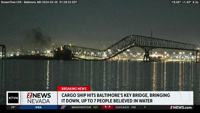


The head of a supply chain management company says Americans should expect shortages of goods as the Baltimore bridge collapse affects ocean container shipping and East Coast trucking logistics.
“It’s not just the port of Baltimore that’s going to be impacted,” said Ryan Petersen, CEO of Flexport.
Petersen says attacks on cargo ships in the Red Sea connecting Asia with Europe and the United States have forced traffic away from the Suez Canal and around the tip of Africa. At the same time, there’s been increased congestion in the Panama Canal. Petersen says U.S. importers are increasingly shifting to West Coast ports which in turn may have their own back-ups.
“You get this vicious feedback loop,” he said.
Petersen was working with his team Tuesday to reroute about 800 shipping containers currently making their way to Baltimore’s port.
“It’s a scramble because each of those containers has now a new journey to clear customs, you’ve got to get a different truck to pick it up at a different port, it creates a whole lot of downstream work,” he said.
The initial crash caused the span to buckle into the river below and plunged a construction crew and several vehicles into the dangerously cold waters. Rescuers pulled out two people, but six others were missing.
The ship’s crew issued a mayday call moments before the crash took down the Francis Scott Key Bridge, enabling authorities to limit vehicle traffic on the span, Maryland’s governor said.
BALTIMORE BRIDGE COLLAPSE: Photos released by the Baltimore City Fire Department reveal the aftermath of the Francis Scott Key Bridge collapse early Tuesday morning after being hit by a cargo ship. https://t.co/5JMoAck6Rz
— CBS News (@CBSNews) March 26, 2024
📸 BCFD Rescue 1 team pic.twitter.com/GBAQHRf4rw
The #FrancisScottKeyBridge collapsed in #Baltimore, Maryland, around 1:30 a.m. ET today after being hit by a cargo ship. About an hour ago, two Maxar satellites collected imagery of the collapsed bridge and ship. A May 2023 image is also in the gallery. #viewfromspace pic.twitter.com/UyUuxzDo9p
— Maxar Technologies (@Maxar) March 26, 2024
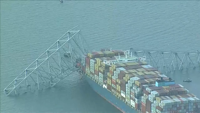
The ship struck one of the bridge’s supports, causing the structure to collapse like a toy. It tumbled into the water in a matter of seconds — a shocking spectacle that was captured on video and posted on social media. The vessel caught fire, and thick, black smoke billowed out of it.
With the ship barreling toward the bridge at “a very, very rapid speed,” authorities had just enough time to stop cars from coming over the bridge, Maryland Gov. Wes Moore said.
“These people are heroes,” Moore said. “They saved lives last night.”
The crash happened long before the busy morning commute on the bridge that stretches 1.6 miles (2.6 km).
The ship crashed into one of the bridge’s supports, causing the structure to break apart like a toy. It tumbled into the water in a matter of seconds — a shocking spectacle that was captured on video and posted on social media. The vessel caught fire, and thick, black smoke billowed out of it.
“Never would you think that you would see, physically see, the Key Bridge tumble down like that. It looked like something out of an action movie,” said Baltimore Mayor Brandon Scott, calling it “an unthinkable tragedy."
Fire Chief James Wallace said authorities “may be looking for upwards of seven people” but said that number could change and other officials wouldn't give figures. It was not clear if the two rescued were included in the seven cited by the fire chief.
Synergy Marine Group — which manages the ship, called the Dali — confirmed the vessel hit a pillar of the bridge at about 1:30 a.m. while in control of one or more pilots, who are local specialists who help guide vessels safely into ports. The ship is owned by Grace Ocean Private Ltd.
Synergy said all crew members and the two pilots on board were accounted for, and there were no reports of any injuries.
The ship was moving at 8 knots, roughly 9 mph (14.8 kph), the governor said.
Authorities said a crew of unknown size was working on the bridge at the time of the collapse and that sonar had detected cars in the water, which is about 50 feet (15 meters) deep. The water temperature was about 47 degrees Fahrenheit (8 degrees Celsius) before dawn Tuesday, according to a buoy that collects data for the National Oceanic and Atmospheric Administration.
Earlier, Kevin Cartwright, director of communications for the Baltimore Fire Department, told The Associated Press that several vehicles were on the bridge at the time of the collapse, including one the size of a tractor-trailer truck. The bridge came down in the middle of night when traffic would be lighter than during the day when thousands of cars traverse the span.
Cartwright called the collapse a “developing mass casualty event,” though he didn't know at the time how many people were affected.
As the sun rose Tuesday, jagged remnants of the bridge were illuminated jutting up from the waters surface. The on-ramp ended abruptly where the span once began.
Cartwright said that some cargo appeared to be dangling from the bridge, which spans the Patapsco River at the entrance to a busy harbor. The river leads to the Port of Baltimore, a major hub for shipping on the East Coast. Opened in 1977, the bridge is named for the writer of “The Star-Spangled Banner.”
Maryland Transportation Secretary Paul Wiedefeld said all vessel traffic into and out of the port would be suspended until further notice, though the facility was still open to trucks.
Gov. Wes Moore declared a state of emergency and said he was working to get federal resources deployed. The FBI was on the scene, but said there was no credible information to suggest terrorism. President Joe Biden was briefed.
The Dali was headed from Baltimore to Colombo, Sri Lanka, and flying under a Singapore flag, according to data from Marine Traffic. The container ship is about 985 feet (300 meters) long and about 157 feet (48 meters) wide, according to the website.
Danish shipping giant Maersk said it had chartered the vessel, which was carrying its customers’ cargo. No Maersk crew and personnel were on board. The collapse caused Maersk share at the Nasdaq Copenhagen to plummet 2% in early Tuesday trading.
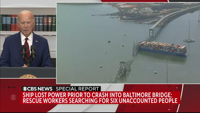
President Joe Biden said he planned to travel to Baltimore and intends for the federal government to pick up the entire cost of rebuilding.
“This is going to take some time,” Biden said. “The people of Baltimore can count on us, though, to stick with them at every step of the way until the port is reopened and the bridge is rebuilt.”
In 2001, a freight train carrying hazardous materials derailed in a tunnel in downtown Baltimore and caught fire, spewing black smoke into surrounding neighborhoods and forcing officials to temporarily close all major roads into the city.
Last year, the Port of Baltimore handled a record 52.3 million tons of foreign cargo worth $80 billion, according to the state.
The collapse, though, is not likely to hurt worldwide trade because Baltimore is not a major port for container vessels, but its facilities are more important when it comes to goods such as farm equipment and autos, said Judah Levine, head of research for global freight booking platform Freightos.
(Copyright 2024 The Associated Press. All rights reserved. This material may not be published, broadcast, rewritten or redistributed without permission.)