
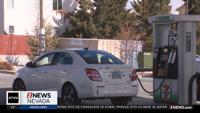


Prices at the pump are going up as a result of the war in Iran, including right here in Nevada.
"I mean, eventually, it's going to be pretty hard to do anything," said Connor Eggen, a Reno resident.
Some are worried about the recent rise in gas prices.
Eggen works for DoorDash and says it's getting even harder.
"The gas prices themselves, like, you know, I get $8 for a DoorDash (order) that takes me 40 minutes to go do, that kind of doesn't fill in that gap," Eggen said.
The conflict in Iran is causing oil and gas shipments to be stranded in the Persian Gulf.
Depending on how long this goes, prices will continue to climb.
"Unfortunately, when international issues occur, such as this, Nevada is one of the states that it impacts not only directly but almost immediately," said Miranda Hoover, State Executive, Energy and Convenience Association of Nevada.
Part of that is due to the fact that Nevada imports most of its fuel and oil, 88 percent from California.
California gets more than 50 percent of its crude oil from sources around the globe. So, the domino effect hits Nevada pretty hard.
"I don't expect Nevada's prices to go any lower until we can truly build some of our own resilience and diversification," Hoover said.
2 News Nevada has covered in the past about ways Nevada is looking to diversify its fuel sources.
Hoover says the state needs to expand its sources to bring costs down.
The increase also comes at a time when two refineries in California are closing, and most others are switching to summertime blends.
Summertime blends are typically more expensive because there are additives to keep gas from evaporating in the heat.
Once the conflict in the Middle East is over, it will still take a bit of time to see prices ease up.
"It could take anywhere from seven to 14 days for them to get across the ocean, come into California, and then for that oil and gas to be pumped over to Nevada," Hoover said.
For those planning to ditch gas to go to electric, Hoover says to consider utility costs for your electric bill and account for where and how far you have to travel on a daily basis.
Since there doesn't appear to be an end in sight, there are a few ways you can stretch your dollar for your tanks of gas.
"I would tell consumers to be very, very cognizant of how often they're driving their cars for the next two weeks," Hoover said.
Driving less, taking public transportation, or carpooling is an option, but not always the most convenient.
Quick acceleration, constant stop-and-go traffic, and speeding all burn fuel much faster, according to the U.S. Department of Energy.
Keeping up with maintenance and making sure your tires are at the right pressure are important.
"When tires are lower, it takes more gasoline," Hoover said. "When you put your foot on the gas, it takes more gasoline to pump through the vehicle and get your vehicle to move. When your vehicle needs an oil change or any type of maintenance, it is slowing down your vehicle, and thus you're trying to pump more gasoline through it."
Looking at the statistics from Tuesday to Wednesday, the national average for a gallon of gas increased by nine cents. In Nevada, it rose by a whole dime, and in Reno, it rose six cents.