


The Bonanza King Mine is a relic of Nevada's history. Prospectors located the lode mine in Pershing County's Spring Valley Mining District in 1868, just three years after Nevada gained statehood.
"It's an area that's well-endowed with silver and gold, a lot of historic production in the general area," Michael Visher, Administrator of the Nevada Division of Minerals said.
The mine is patented, so it is located on private land with physical proof of gold and silver.
"What is interesting about it is that it has a mineral estate, it has documented some aspect of production," Visher said.
The Bonanza King Mine recently went up for sale with a price tag of $40 million.
"We actually have real money in this ground. Gold and silver," April Nieto, realtor for Sierra Sotheby's International Realty said. "Whoever buys this is going to definitely get a return."
The mine dates back to the days of John Mackay and the Comstock Lode.
"It's definitely a connection to the Comstock Lode," Nieto said. "It's part of the same geological area."
Fred Quinto purchased the mine in 1980 but never had the means to start production. Nieto says nobody has mined the Bonanza King since before World War II.
"In those days, we had a 15-stamp mill down here at the junction and it basically was a stamp mill," Nieto said. "It couldn't process sulfide ore, so production just kind of halted."
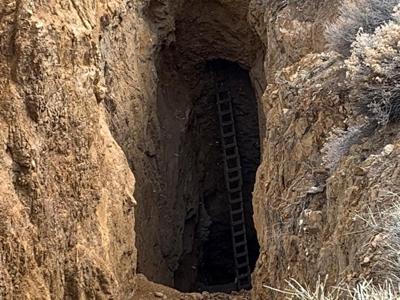
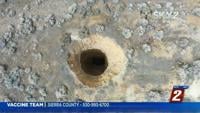
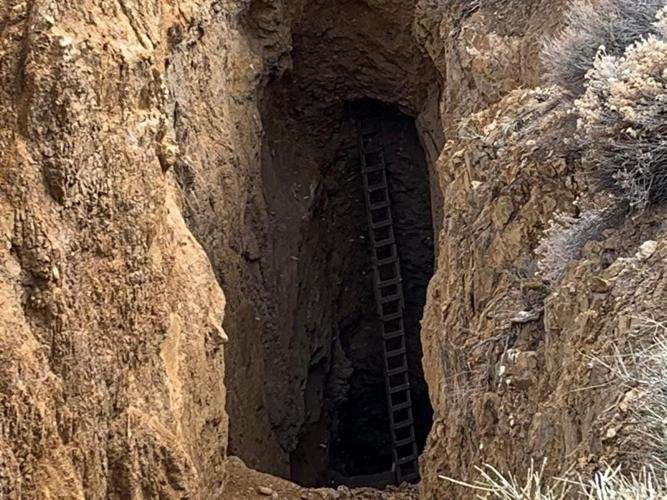
Nieto says with today's technology, the gold and silver could be extracted. The remaining mine includes a few ventilation shafts, a long cut in the ground and a 300-foot main shaft. She says the ore goes several hundred feet deeper than the current depth of the mine. She says Quinto's goal is to sell the mine to a company that will start production again, preferably an American company.
"He would love to see it go into production and actually live to see that happen," Nieto said. "So that is one of the reasons he wants to sell it. We would love to keep it local. We would love for this to benefit the people of Pershing County."
Visher says today's underground typically require about 100 acres to operate. The Bonanza King Mine is only 20.66 acres. It is also surrounded by other claims on both public and private land.
"If it's sufficiently high in grade, you can accomplish quite a bit," Visher said. "If it's not, you're going to need land to get the same payback."
The mine also comes with apex extralateral rights, meaning the owner would have the ability to mine the vein of ore if it stretches past its vertical boundaries. Visher says that is not a simple process though.
"It's subject to a lot of litigation and a lot of science to prove that you're actually entitled to pursue those," Visher said.
The Bonanza King Mine is about 27 miles northeast of Lovelock, just a few miles away from Coeur Rochester, an operating open-pit mine, so the precious metals are well-known in the area. If someone purchases the mine, they would have some permitting and other work to do before mining could begin.
"The first thing that needs to be done is really drill out the resource, determine what's there and you're going to do that from the surface, figure out what it looks like in three dimensions, underground, before you actually drop your underground mine plan," Visher said.
Mining has become a critical economic driver in Nevada since the 1850s. The state is typically the leader of gold production in the United States. If it were a country, it would be the fifth largest producer behind China, Australia, Russia and Canada.
"Nevada is the Silver State that we mine a lot of gold here in Nevada and we do that by disturbing less than one-half of one percent of all land in Nevada," Tyre Gray, President of the Nevada Mining Association said.
Whoever purchases the mine does not have to use it for mining purposes. Since it is private, it could be used for a lot of different things, including real estate development.