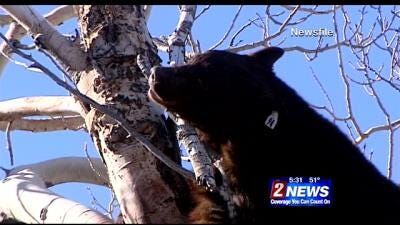
We're seeing an unusual number of bear sightings for this time of year. Just a few weeks ago, a few bears were caught by the Nevada Department of Wildlife (NDOW), and now, wildlife officials are making sure everyone is prepared.
Normally, the bears would be hibernating at this point, but NDOW Public Information Officer Chris Healy says the dry weather conditions in recent years are waking them up.
"When you don't have snowpack, and when food is still available to bears, whether it'd be wild food, or whether it'd be in the form of garbage -- the bears will avoid hibernation, as long as they can gather enough calories, to make it worth their while to at least wake up from a partial nap and go out and consume food."
Wildlife officials are hoping this winter will bring a lot of snow, so the bears are more motivated to take their natural winter sleep.
"If we are indeed in a major climate shift, where snow is hard to come by, and 55-60 degree days are going to be common in the month of January, then you have the very real possibility of altering a bear's behavior in the long-run," Healy said.
That means they could be scouring the neighborhoods for some food because they are looking for more than just nuts and berries.
"You go around the nuts and berries, it takes awhile to get the calorie load you need, going into a human garbage can, or a series of garbage cans left out in a neighborhood," Healy said.
If a bear gets to your house or car, it can be costly. Insurance agents with State Farm and American Family told Channel 2 News the damage can range from $2,000 to around $8,000 depending on the destruction.
"The bears can't alter their behavior, if humans don't alter theirs," Healy said.
So, NDOW has a few tips to hopefully keep bears out of your neighborhood. One, put your garbage out on the morning of your pick-up day.
If you have a fruit tree, make sure all of the fruits are harvested and pick up any stray pieces off the ground.
If you want to report a bear sighting, call the NDOW Bear Hotline at (775) 688-2327.