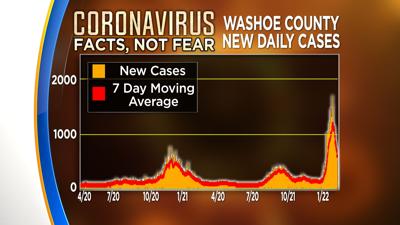



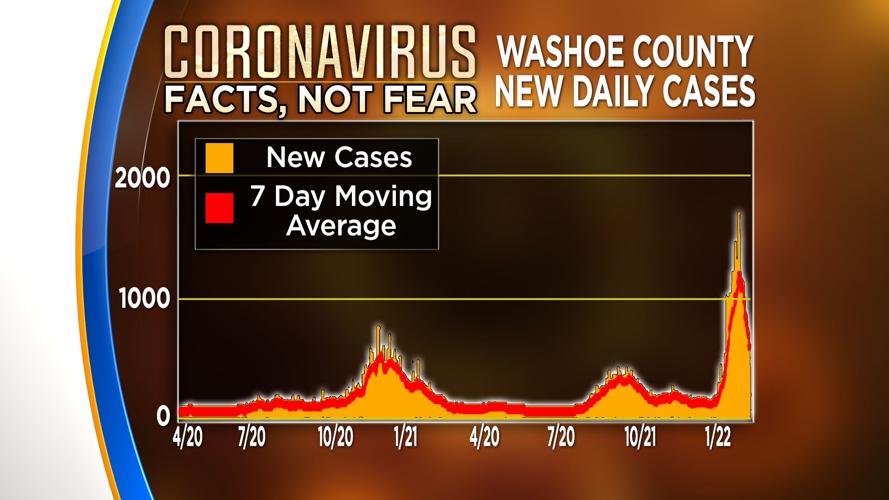
The Omicron wave appears to be well on its way down the back side of the curve. Average daily new cases in Washoe County have dropped from 1,163 on January 21, to 567 on February 3. That is a decrease of more than 50 percent in less than two weeks.
"I don't know that it's a relief as much as it gives me a hope that we'll continue to see a decline and I would not ever want to see an increase again," Gayle Erickson, Program Coordinator for COVID at the Washoe County Health District said.
The steady drop in the case count is a welcome site but it is still very high. The latest numbers would have been a record, four weeks ago. Washoe County is still averaging 88 more cases each day than it did during the previous peak in November, 2020. It reached 479 during that wave. Erickson says people should not take the numbers lightly, even as they drop.
"Whenever you hit a relative high, we just think it's going down but we don't remember that it's still high," Erickson said. "It's still a very high level."
The drop in cases coincides with a drop in demand for COVID testing. 100 people scheduled appointments at the WCHD's testing site at the Reno-Livestock Events Center, Thursday. It had been testing up to 300.
"We are planning to move back to our operations we were running at the beginning of January, which would be Monday, Wednesday, Friday testing 9:00-12:30 and up to 300 people per day who can come in over those three days," Erickson said.
Erickson says other partners like pharmacies and the community testing sites are also seeing a drastic decline in demand. The lower numbers mean the National Guard's help will not be needed.
"The intention is to be able to go ahead and demobilize the National Guard and that will be taken up with the resource, itself, in order to determine that timing," Erickson said.
The Center for Disease Control and Prevention still has Washoe County's test positivity rate at 38.76 percent. The World Health Organization's threshold is five percent, so community transmission is still very high.
Deaths are also rising. On average, less than one person was dying each day for the first three weeks of January. That number has tripled over the past week.
"We've had 19 deaths, even over the last seven days that have been reported back to us," Erickson said.
The death rate is expected to climb during the next few weeks.
Ericson says it is still very important to take mitigation efforts seriously.
"We just have to continue to make sure we take care of our family and our friends," Erickson said. "We have to make sure we do what we need to do to keep everybody safe around us."
The decrease in cases is expected to cause a decline in hospitalizations and deaths.