

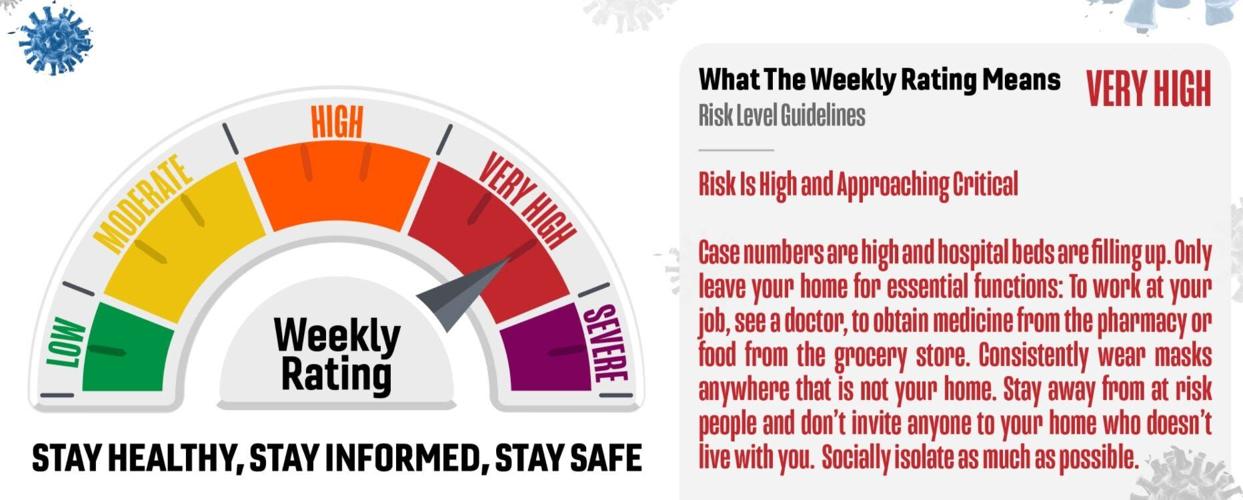
With the numbers of infections, hospitalizations and deaths increasing, the Truckee Meadows COVID Risk Meter is also rising.
With the help from an aerospace engineer professor, experts hope to give us a better idea of exactly what the future will look like here in Northern Nevada.
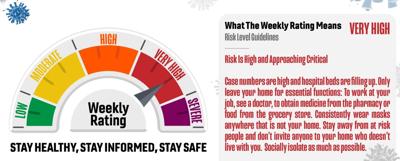
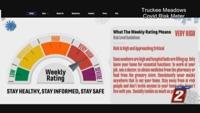
The Truckee Meadows COVID Risk Meter, which measures a variety of different local trends from hospital capacity to test positivity rates, has been sitting in the "very high" range with a score around 13 since the end of October. Experts say it will most likely increase to the highest level of "severe" with a 13.5 score as early as Wednesday.
“We are seeing a dramatic rise in not only illness, but the severity of illness,” said Dr. John Hess with Saint Mary’s Medical Group. “Over the last couple of weeks, we are having more COVID deaths than cancer and heart disease deaths combined."
“We have had more deaths in the last seven days that we had an entire month of October,” said Dr. Laura D. Knight, Chief Medical Examiner and Coroner for Washoe County.
While the hospitalization numbers have dropped slightly in Washoe County, it may not be for the reason many hope for.
"We are sort of seeing a flattening in hospitalizations, but I fear that some of that is actually due to the deaths. We are clearing out space because people die," said Dr. Hess.
With the increase in deaths, officials are worried about space to store those who succumbed to the virus.
“Unfortunately as deaths continue to increase our regional capacity to store the bodies of the deceased and refrigeration really becomes an issue," said Dr. Knight.
With the help of an aerospace engineer at the university, the group who puts together the risk meter is working on a way to look seven to ten days in the future to predict where current levels could go.
"I put that score together on a Monday, and I look back to the previous week to set the next weeks setting, and at the same time I pass on the data to Aditya to run the prediction," said Dr. Jeremy Smith with the Truckee Meadows Regional Planning Agency.
"It's basically showing mostly local linear trends in the data and where we are heading towards," said Dr. Aditya Nai, Assistant Professor and Aerospace Engineer of the University of Nevada, Reno’s Department of Mechanical Engineering.
Dr. Nair says this prediction, which uses a model called sparse identification of nonlinear dynamics, and works a lot like a weather forecast, and has the power to predict how both the hospitals and public should plan ahead.
While the predictive model shows cases getting worse, the hope is that, armed with knowledge and the public's help, we can turn those numbers around.
"That model tells us where we are heading, and that model is absolutely disastrous," said City of Reno Mayor Hillary Schieve.