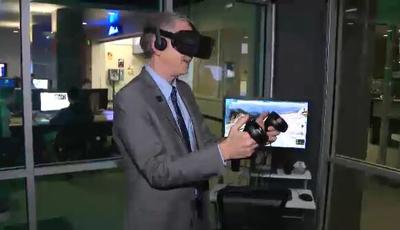
Scientists are finding all sorts of new uses for virtual reality technology, from immersion therapy for patients to training for dangerous jobs. But they've hit a roadblock, in the form of "VR sickness," which afflicts a surprisingly large portion of the population and puts a damper on the potential for VR technology.
Now, researchers at the University of Nevada are working to find a solution.
"It's that conflict between the visual cue to self motion and the vestibular cue to self motion that actually causes motion sickness," UNR Neuroscientist and Assistant Professor Paul MacNeilage said, "But also the kind of technological version of motion sickness, which is VR sickness or simulator sickness."
Basically, the visual part of your brain thinks you're moving and the other parts say you're not so it causes a conflict, which makes you sick. MacNeilage said roughly 70 percent of the population can experience some VR sickness depending on the situation, it appears to be significantly worse with women. He said that's possibly because of some biological differences in the inner ear.
VR sickness is a problem they want to solve, because if they can, then some of their other research has much more potential for growth. Right now, the lab at UNR is working to help NASA train astronauts for zero gravity.
"If you could get VR to work underwater, you could actually simulate floating in zero gravity," MacNeilage said, "And maybe this could be a tool that's useful to NASA."
The full interview with Paul MacNeilage will air on Face the State this weekend. It's airing Saturday at 4:30 a.m. and 3:30 p.m., and on Sunday at 6:30 a.m. and 4 p.m.