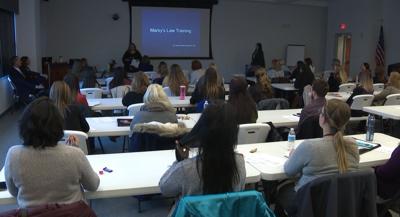

Tuesday the Washoe County District Attorney's Office held a seminar to inform representatives from victim advocacy groups about changes to their system with the implementation of Marsy's Law.
"We absolutely love the idea of giving victims more rights," Rachelle Pellissier, who works at the Crisis Call Center, says.
Tuesday's seminar basically explained how the DA's office interpreted the law, and how that interpretation led to the changes in their system. Those changes are centered around improving communication with victims, and protecting them through improved confidentiality.
"Now we are sending out the appropriate victim letters immediately so victims are made aware of their rights," Washoe County District Attorney Chris Hicks says. "We're providing informative brochures for law enforcement to give to victims, victim advocates like here today."
"We're actually putting automated systems in place," Law Officer Manager for the Washoe County DA's Office Lori Fralick says. "So hopefully people are not slipping through the cracks and that we're doing a better job with it, and I'm hoping it will do that across the state."
Pellissier says before Marsy's Law, communication was a huge problem, and she's happy with the DA's system. It gives victims the option to get be notified of whatever proceedings they desire, whether that's all of the, or just the outcome.
"The process is very long and we don't communicate what the process is to victims appropriately," Pellissier says.
She also worked with victims who experienced harassment, and she's happy to hear victim's name and contact information will not be disclosed to the defendant.
"Their name is given out to the defendant," Pellissier says. "Then family and friends will contact them and harass them."
Marsy's Law was passed as Ballot Question 1 in November 2018, with implementation starting only a few weeks later. First The DA's office trained their entire staff including attorneys, then they went around to judges and law enforcement.
"It is our attorney's interpretation that [the law] kicks in as soon as the crime is committed, not necessary when it's charged," Fralick says. "So we need law enforcement at the table to understand what they could do."
The passing of Question 1 also means the law is added to the Nevada state constitution, and Hicks says that gives victims more standing in court, and makes victim's rights a higher priority.
"At a statewide level it's required," Hicks says. "Victims are required to be informed, protected, have their say in court. And that's important. That's something that's sometimes lost in the criminal justice system."
"It's really good that the District Attorney's Office is being so proactive to reach out to all of us so we're all working together," Pellissier says.