

President Donald Trump is encouraged by Supreme Court nominee Brett Kavanaugh's passionate denials of Christine Blasey Ford's claims that he sexually assaulted her in high school.
A White House official told The Associated Press on Thursday that the West Wing saw the judge's opening statement as "game changing" and said Trump appeared to be reacting positively.
Trump watched the Senate Judiciary Committee hearing on Air Force One as he traveled from New York, then resumed monitoring back at the White House.
Two Republicans close to the White House say Trump expressed sympathy for Kavanaugh and his family for having to listen to Ford's tearful recounting of allegations. After seeing Ford's testimony, White House aides and allies expressed concern that Kavanaugh would have an uphill climb to deliver a strong enough showing.
But they say Trump was encouraged by Kavanaugh's performance.
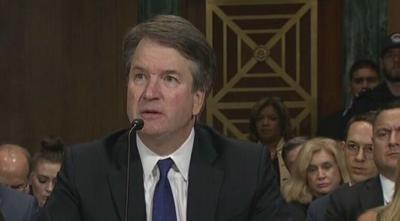
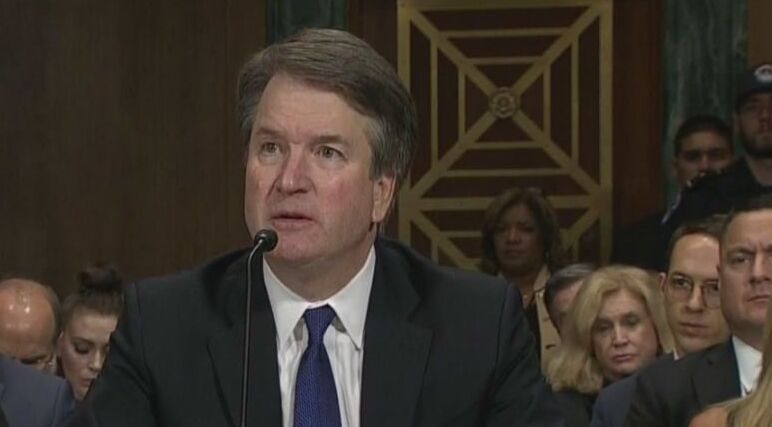
Kavanaugh called certain allegations against him a "joke" and a "farce."
Kavanaugh made the statements while testifying Thursday before the Senate Judiciary Committee following allegations by Ford that he sexually assaulted her in high school. Allegations by other women followed those by Ford.
Kavanaugh was referring specifically to allegations by Julie Swetnick, whose name and allegations became public Wednesday, a day before the hearings. Swetnick said in a sworn statement that she witnessed Kavanaugh "consistently engage in excessive drinking and inappropriate contact of a sexual nature with women in the early 1980s."
Kavanaugh was responding to questions from Democratic Sen. Dianne Feinstein when he said: "The Swetnick thing is a joke, that's a farce."
Feinstein asked Kavanaugh if he wanted to say more about Swetnick's allegations. Kavanaugh responded: "No."
Earlier he told the panel that his family and his name "have been totally and permanently destroyed."
Kavanaugh spoke after Blasey Ford. She said she was terrified to come forward but did so because she felt it was her civic duty.
He says his confirmation process has become "a national disgrace" and a "character assassination."
He lashed out at the committee over the time it has taken to convene the hearing after Christine Blasey Ford's allegation first emerged. He says, "This is a circus."
He urged senators to listen to the people who know him and not those making grotesque allegations against him.
Kavanaugh says the allegations are false.
She says the attack is seared in her memory and she is "100 percent" certain that it was Kavanaugh who attacked her.
Ford also said she doesn't have any political motivation for coming forward with accusations of sexual assault against Supreme Court nominee Brett Kavanaugh when they were teenagers.
When Democratic Sen. Mazie Hirono of Hawaii asked Ford about her motive for appearing, Ford said she'd been trying to get the information on the alleged assault to the committee while there was still a list of potential high court nominees.
Kavanaugh has denied the allegation, and he's set to address the committee later Thursday.
"Listen to the people I know. Listen to the people who've known me my whole life," Brett Kavanaugh says at the opening of his testimony. https://t.co/wkM6MaQZZI pic.twitter.com/n8Iin0JfiE
— CBS News (@CBSNews) September 27, 2018
"Think about that fact": Kavanaugh quotes a letter from an attorney for one of Ford's friends who said she doesn't remember seeing him at a party https://t.co/9FalHY71EC pic.twitter.com/eHVDXXky5g
— CBS News (@CBSNews) September 27, 2018
Kavanaugh chokes up recalling how his 10-year-old daughter showed sympathy toward Dr. Blasey Ford the other night, telling her mother, "We should pray for the woman" https://t.co/9FalHY71EC pic.twitter.com/jRG6sxgDLb
— CBS News (@CBSNews) September 27, 2018
Earlier, Ford said she "agonized daily" over the decision on whether to come forward to speak about sexual assault allegations against Kavanaugh.
She told the committee that Kavanaugh barricaded her in a bedroom at a house party during high school and got on top of her and assaulted her.
She says that over the years, she convinced herself that because she was not raped, she should just pretend that it didn't happen. But when it became clear Kavanaugh would likely be named to the court, she said she faced a difficult choice.
She says that she sent a letter detailing the allegations to Sen. Dianne Feinstein of California but had planned not to come forward. But the letter was leaked to the press. She then decided that she should speak out to tell her story in her own words.
She says her goal is to be helpful.
Ford says no one helped write the letter she sent privately to Sen. Dianne Feinstein outlining her sexual assault allegation against Kavanaugh.
Asked Thursday by attorney Rachel Mitchell at the Senate Judiciary Committee hearing if Ford had any help, Ford answered flatly, "No."
Ford explained how she was weighing whether to come forward about the incident from 35 years ago. Kavanaugh denies assaulting her when they were teens.
Ford first brought her concerns privately in July to her congresswoman, Anna Eshoo. The California Democrat suggested she write the letter to Feinstein.
Ford described a "fairly brief" phone call with Feinstein once the senator had received the letter.
Ford says also she started interviewing lawyers because the few other people she had told said she would need one.
Ford says she is certain she did not mistakenly identify Kavanaugh as her attacker at a party when they were both in high school more than 30 years ago.
Ford was responding to questions from Feinstein about how she could be sure it was Kavanaugh and not someone else who assaulted her in the bedroom of a home in a Maryland suburb of Washington, D.C.
Ford said, "The same way I am sure I am talking to you right now."
Feinstein said: "So what you are telling us is this could not be a case of mistaken identity."
Ford's response: "Absolutely not."
She says that the assault has been seared into her memory and has haunted her.
She says Kavanaugh held her down on a bed during a party with a few other high school kids and assaulted her, and put his hand over her mouth so she could not scream. She says she thought he would try to rape her.
Kavanaugh has denied any allegations. He will speak to the committee later Thursday.
The 11 Republican and 10 Democratic members of the panel will have five minutes each to question Ford and Kavanaugh in alternating turns.
Republicans have hired an outside attorney, Phoenix prosecutor Rachel Mitchell, to handle much of their questioning.
Kavanaugh's confirmation seemed assured until Ford accused the appeals court judge of attempting to rape her when they were high school teenagers. Kavanaugh has denied any sexual misconduct then or in college at Yale, though more women alleging sexual misconduct have come forward.
Meanwhile, President Trump has acknowledged that the accusations of sexual misconduct swirling around his Supreme Court nominee have a personal side for him.
Trump told reporters Wednesday that similar accusations of sexual misconduct against him have colored his views of the accusations against Kavanaugh and other men.
Trump has denied such allegations and told reporters Wednesday he's been accused by "four or five women." In fact, more than a dozen women came forward during the 2016 campaign to claim they were assaulted, groped or kissed without consent by Trump.
(Copyright 2018 The Associated Press. All rights reserved. This material may not be published, broadcast, rewritten or redistributed.)
Senator Feinstein: How are you so sure that it was [Kavanaugh]?
— CBS News (@CBSNews) September 27, 2018
Dr. Blasey Ford: The same way that I'm sure that I'm talking to you right now – just basic memory functions. https://t.co/hib1LKoWh8 pic.twitter.com/04ERUtZoud
"The details about that night that bring me here today are the ones I will never forget. They have been seared into my memory and have been hard to beat episodically as an adult," Dr. Blasey Ford says of night she was sexually assaulted by Brett Kavanaugh. https://t.co/hib1LKoWh8 pic.twitter.com/Xi4W8MC67T
— CBS News (@CBSNews) September 27, 2018
"I believed he was going to rape me...This is what terrified me the most and has had the lasting impact on my life," Dr. Blasey Ford says of Supreme Court nominee Brett Kavanaugh. https://t.co/hib1LKoWh8 pic.twitter.com/qy76bRULSz
— CBS News (@CBSNews) September 27, 2018
WATCH: Dr. Christine Blasey Ford is sworn in by Senate Judiciary Committee Chairman Chuck Grassley (R-IA) before delivering opening statement, testimony https://t.co/j0e7TIiavz pic.twitter.com/GbCxYjuKeY
— CBS Evening News (@CBSEveningNews) September 27, 2018
Supreme Court nominee Brett Kavanaugh, Dr. Christine Blasey Ford will testify later before lawmakers Thursday morning on sex assault allegations. Follow our live blog for updates: https://t.co/VFCuyD1TAL pic.twitter.com/13raRzMIWy
— CBS News (@CBSNews) September 27, 2018