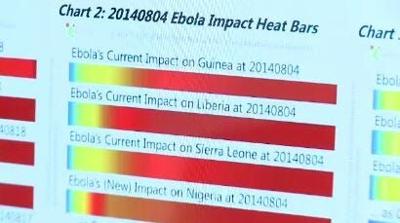
Dr. Jim Wilson studied the Ebola virus, in the rain forests of West Africa, in the late 1990s. The University of Nevada faculty member and Director of the National Infectious Disease Forecast Center says it's important for American hospitals to be prepared for the virus, but he doesn't expect it to reach pandemic levels.
"People have the misconception that we're looking at a pandemic, we're looking at a global catastrophe," Wilson said. "That absolutely is not the case."
Wilson says the Ebola Virus is only spread through bodily fluids like blood, vomit, and waste. Still, 18% of American doctors incorrectly believe the illness is airborne.
"The facts are this is not an airborne virus," Wilson said. "You have to be close to the patient and they have to directly transfer their bodily fluids, somehow, to you."
Wilson says the chances of a case turning up in Nevada are small because of the air traffic in the state, and there are very few West Africans living here.
"From that standpoint, it's very low risk for us to get caught by surprise from somebody coming off an air flight," Wilson said. "The problem is, it's not impossible."
California has a much higher probability, compared to most states. Wilson says suspected Ebola cases overwhelmingly come back negative and he expects the same results in the Sacramento case. But he says the proper steps are being taken.
"One thing we know is if you get surprised with Ebola, the outcomes are poor, compared to an area that is well-prepared, has already begun the discussion of how to handle these suspect patients," Wilson said.
Developed countries have more capabilities to prevent the spread of Ebola, compared to West Africa, where access to good hygiene and treatment is limited.
"If you have a developed country who's used to handling these situations, very quickly, and has a very robust medical infrastructure and public health infrastructure, you can respond very quickly and stamp this out very quickly," Wilson said.
The Ebola virus is believed to be carried by fruit bats that transmit it to humans and monkeys, possibly through feces. Outbreaks seem to come and go, and Wilson says one theory is that the virus follows ecological cycles, like drought.
While Ebola is the hot topic right now, it's not Wilson's number one concern. He said he worries more about strains of influenza that we haven't seen before, just because the flu is transmitted so easily.