

Farmers are getting older, and younger people aren't stepping up to provide the food, feed, fuel, and fiber we need.
The Nevada Department of Agriculture's 2021 Economic Analysis of Food and Agriculture Sector in Nevada shows that the fastest growing age of farmers in the state were those between 55 to 74 years.
In Washoe County, just 8.5% of farms were owned by someone 35 or younger.
As Nevada farmers retire and fewer younger farmers take over, how can artificial intelligence and automated technology help with work shortage?
We took that question to the dairy capitol of northern Nevada, Fallon.
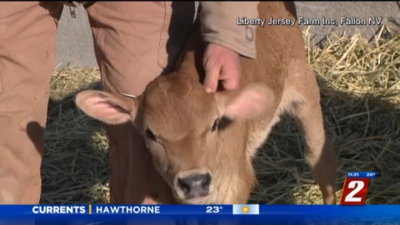
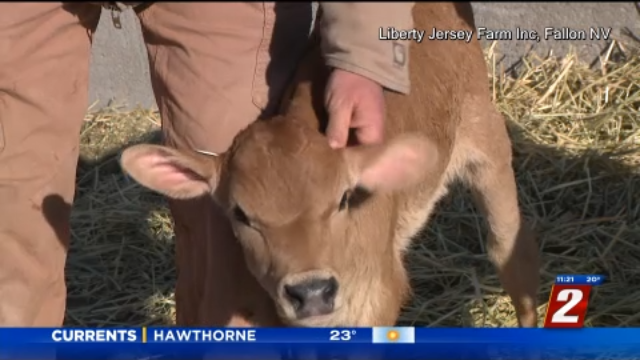
Ted Christoph, a sixth-generation dairy farmer, manages 625 head of dairy cows at Liberty Jersey Farm.
"It's definitely a problem because who's going to carry the torch," said Liberty Jersey Farm, Inc. President Ted Christoph.
Farming is a challenging and demanding profession that requires hard work, dedication, and perseverance. With the labor shortage, it only adds to the challenges farmers face in managing their operations.
"Unfortunately, in agriculture, we're just cost takers, so basically, we're told what we're going to get paid for our milk, and we're told how much we're going to pay for feed," explained Christoph.
Doug Busselman, the Nevada Farm Bureau's Executive Vice President, says artificial intelligence could address the labor shortage issue.
"Having farm workers who are available and affordable to be involved in an operation today, and AI is coming on where it can, mainly as an alternative because they can't get the labor they need," said Nevada Farm Bureau Executive Vice President Doug Busselman.
Christoph says that automated cow collar monitoring is a significant advancement for his operation.
"The collars that we have, that tracks data, tracks rumination, tracks eating habits, tracks health information," explained Christoph, "It allows us to have a better feel for what's happening with the cows; we don't have to spend as much time with the cows."
The collars transmit data directly to the milking machines via antennas, which identify each individual cow and can sense the cow's biology to stop milking when it's appropriate.
Sage Hill Dairy, also in Fallon, provides an automated calf feeding system. They say the new technology is leagues ahead of traditional feeding.
"The calf is able to go to a machine that automatically produces exactly what that calf is supposed to be getting," explained Busselman.
With labor shortage limiting production, farmers are looking to the near future, humanoids.
"As long as their batteries are able to function, you can put them on multiple tasks, teach them multiple different things, or if you have to, you just put that humanoid on one task, and does that very well, repetitive," explained Christoph.
"The increased use of technology is not so much coming from trying to put people out of work, as much of the case is that the people aren't in the work in the first place, and we're looking to find alternatives," said Busselman.
Another notable piece: Liberty Jersey Farm has extensive records and data going from their original 50 cows to now with the roughly 8,000 animals they've had on their farm since starting in 1976.