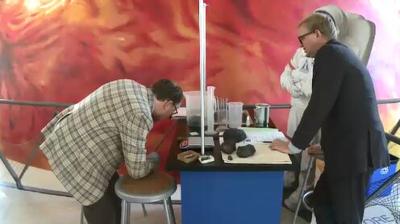
The Quinn Canyon Meteorite is not the only one found in Northern Nevada. Thursday we were able to test a few to see if they pass the test. Filing and measuring density are part of the process.
"Some of them are meteorites and some of them are what we call meteor-wrongs," said Dan Ruby. Ruby works for the Fleischmann Planetarium in Reno.
The first thing they do is a visual inspection.
"From that we can usually tell if something is not a meteorite," said Ruby.
Is the rock dark? Is it smooth? The last step is to do a nickel test.
"But this has no nickel in it so I'm going to tell you 'Garrett I'm sorry this is likely not a meteorite,'" answered Ruby.
Garrett Barmore works for the W.M. Keck Museum on the University of Nevada, Reno campus. He brought along some previously collected samples to see if they came from space.The planetarium says the rocks they test can be found by almost anyone.
"A couple weeks ago we had a woman that found one near the top of a tree and that was exciting because what a weird place to find a meteorite. A few weeks ago before that we had a kid maybe like ten years old that found one and brought it in with his family. That was exciting," said Ruby.
While one of Barmore's rocks is probably not a meteorite, the second one he brought in was hard to test. Results came back inconclusive.
"In museums we don't really talk about value of objects in regards to money. For us it's the scientific value and having objects on display," said Barmore.
"I usually tell people if you think it might be a meteorite that's the coolest part about it. It's just a good story," said Ruby
It's also a great way to learn about science.
The purpose of the experiment is not to guarantee you have a meteorite but it is to either disqualify the rock or to require further testing.