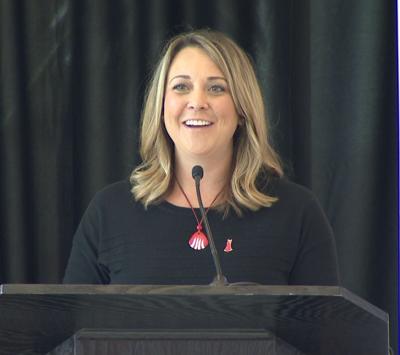
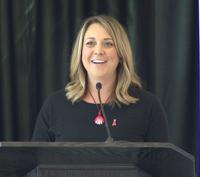
Five months ago, Breanna Alosi was enjoying life after her second child was born eight months prior. Then, at the age of 33, she had a heart attack.
"I had pain in my upper back," Alosi says. "And then it moved to my chest and then it radiated through. And then I got really hot and sweaty and short of breath and I knew I needed to get to the hospital."
She was then rushed to the hospital.
"I had an emergency angiogram," Alosi says. "Where they go in your wrist and put in some stents to kind of open up your arteries."
Alosi was later diagnosed with spontaneous coronary artery dissection (SCAD), which is when the inner layer of an artery peels, causing some blood to get stuck behind the open flap. That blood can clot causing a hematoma, or blockage. That's what caused Alosi's heart attack, and led doctors to insert a total of five stents over two surgeries.
While she had no key factors like high cholesterol or high blood pressure, she has a connective tissue disease that weakens her arteries. Her recent child berth could also be a contributing factor.
"Go to your doctor and get checked," Alosi says. "I mean they have medication they have things to fix you. It's life-threatening but in my case fixable."
Alosi shared her story Wednesday at the local Go Red for Women Conference. Go Red for Women is a campaign start by the American Heart Association in 2004. Go Red for Women day is the first Friday of February, and they promote everyone wear red. The day and the campaign are meant to raise awareness for heart disease in women.
"There are some lofty goals with this campaign to be able to reach more individuals," Tiffany Coury, Chair of the Go Red campaign, says. "And to be able to decrease the statistics and the number of deaths. It's still the number one killer of women, and that's at all ages."
According to the AHA, heart disease kills more women annually than all types of cancers combined.
Since 2004, the Go Red campaign has expanded to 42 countries, they've conducted multiple research studies, and pushed for women to be a bigger part of the STEM (science, technology, engineering, mathematics) workforce.
While the campaign has many ways they promote women's health care, the day is about promoting women to take control of their own health.
"What is your nutrition plan? What is your exercise plan? Are you getting enough sleep? Are you managing your stress through meditation or some other formal fashion?" Coury says.
Since the heart attack, Alosi has been doing great, but the near death experience changed her perspective. She says she lives more in the present, and has learned not to stress over things that don't really matter at the end of the day.
"I do have two kids and they're both under five" Alosi says. "And as a new mom the worst thought that crossed my mind was, you know, if something tragic happens to me then I might not be here to take care of them."
She says it's important to check your health with your doctor, and it's important not to hesitate if you think you're having a heart attack.
"If you have short of breath, you're dizzy, you're light-headed, your arm falls asleep, you have pain in your neck or jaw, don't ignore it. You're not just tired, you're not in just normal pain, you might be having a heart attack."