
Meteorologists could talk about weather models for days. There is a lot of information that goes into them. Regardless if they are right or wrong, models are a key part of forecasting. Believe it or not, models are a lot like going to the doctor. Sometimes you need a second opinion.
"They're a big help and it would be difficult to do our job without them," said meteorologist Tony Fuentes.
I then asked Fuentes if the models are always correct.
"Never," replied Fuentes.
Which is why it's our job as meteorologists to weed out the wrong ones.
"It takes some experience. Sometimes it's not always obvious which one you should go with or side with," said Fuentes.
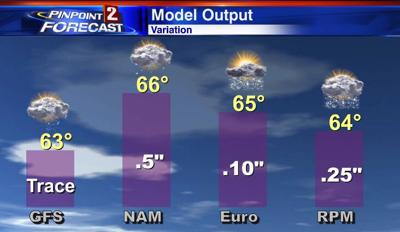
Models are created by big computers that solve hundreds upon thousands of equations. Which then spit out a forecast for what they think will happen. Satellite and radar images are examples of what's going on *now, while models, on the other hand, look into the future. The main ones are the GFS, Nam, Euro, and HRRR model. At Channel Two you may have seen us use the RPM or Futurecast model on air. Each model has different updates or runs that come out at certain times throughout the day.
For example, we have the forecasted high temperature for Sunday on the seven day graphic, but the models may think differently. Some might be warmer than others. Some might keep us dry and others might give us a chance for snow. Totals will often vary as well. Keep in mind this is just an example, not the actual forecast. Just like doctors specialize in certain areas, each model has certain biases or things they do well. The GFS model can sometimes enhance the amount of spillover we'll see during a winter storm.
"There are some models we know tend to rain shadow too much. There are some that handle it a little bit better," said Fuentes.
No model is perfect. If there is a small error in the beginning it becomes a major flaw by the end. Each model starts from the initial time of the run and goes out at least several hours, if not weeks. As a meteorologist it is my job to compare the image on the first frame to the actual conditions. So, for example, is the low in the right spot. Is it too cold? Too warm?
So is a weather model a friend or a foe?
"It's definitely a friend," answered Fuentes.
So while models have their moments when they are wrong, they have also come a long ways over the years. The GFS model just recently got a big upgrade with a finer resolution.