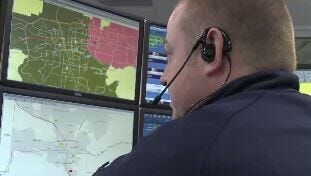
The phones aren’t too busy on this Wednesday morning, but the calls are no less urgent for one dispatcher on a call - “Is she conscious? And is she breathing?”
One thing that seems to stand out when you visit REMSA's call center is how calmly their dispatchers handle an emergency. "You have to be calm,” explains Communication Specialist Ginger Hopfe. “You cannot get emotionally involved in the call, because the person who's calling you is probably having a very scary experience, so they're going to be emotional, they're going to be scared. They may be hysterical."
And yet, these dispatchers are able to provide compassion that’s so desperately needed by the person experiencing the crisis on the other end of the phone.
"Okay, the baby's out? Good! Is the baby crying or breathing? Good!"
The center is open 24 hours a day… with a pod for Care Flight – for those critical situations when helicopter transport is needed, a pod for registered nurses who help patients for free any time of day or night to the dispatchers who handle the medical 911 calls.
Thorough training is what prepares these men and women to handle emergencies. As a matter of fact, a dispatcher must go through six months of training before working alone. It begins with medical skills.
"A lot of them have backgrounds as EMTs or paramedics,” says Adam Heinz, Director of Communications for REMSA, “and they go through a course that allows them to provide over the phone instructions for people in need."
"We are constantly training,” says Ginger, “We are always doing either online training, we sit through meetings almost every month or every other month to get our continuing education."
The calls keep coming in and the advice keeps pouring out. "If you could send someone else, not you or the patient, to get the aspirin…"
Sometimes the training for REMSA staff is about being prepared for a specific season. "We'll go over something like - recently we went over snake bites and envenomation as we enter into the summer months," says Heinz.
The ever-changing world of technology and telecommunications is another thing that REMSA dispatchers have to keep up with. In most cases, the hard work pays off.
After almost two decades with the company, Hopfe says she’s seen much positive advancement. "We can track our ambulances within seconds, we couldn't do that 19 years ago when I started here, it was probably more like a minute, if that. Our phone systems have become much more advanced. We can actually see where they're calling from."
At the end of the day-the certifications, trainings and maps, the data and computer programs are all there to help nurses and dispatchers help us during an emergency.
Ginger has even coached callers through child-birth and on this morning repeats something she’s said countless times - "I know you're scared, but we're gonna get through this together…”
To learn more about REMSA or the 24-hour, free nurse hotline, go to http://remsa-cf.com/