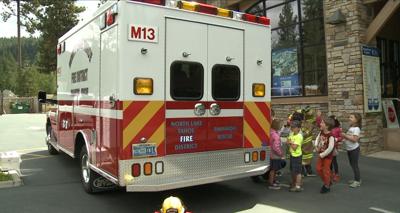
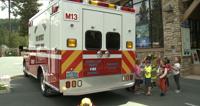
This week is National Emergency Medical Services Week, set aside to acknowledge first responders nationwide. You could see one sign of it today (Tuesday) just outside Lake Tahoe School in Incline Village: an ambulance parked out front. Typically that would be an alarming sight. Firefighter Paramedic Steve Dresher agreed: "Oh absolutely. Everybody's afraid if their child is the reason the ambulance is sitting in front of that child's school all right."
But as Tia Rancourt of the North Lake Tahoe Fire Protection District told us, the paramedics aren't treating. “They’re teaching what an emergency is, what number to call, and what constitutes an emergency." On the other side of the ambulance, an EMT had one student imitate a fall, then asked the rest of the class, “For me to help him, what number do you guys have to call?” In unison, the kids yelled, “911!"
Getting to know 911 early, because those who don't...tie up the system. Dresher told us, “911 is a tool like anything else, and if used improperly, it can cause a lot of problems for the emergency response system." Steve says they get inappropriate emergency calls all the time: "A person with a sniffle…something that a person has no comprehension on how to treat themselves. There are a lot of things that people can treat themselves."
There are 911 calls for stubbed toes and sore throats. They even get calls about pets. At the school, his crew teaches to call only for a true emergency. As one EMT asked the class, "Is choking…is that an emergency?" "Yes!" "How about a car crash?" "Yes!"
And it’s not perfect on the other end of the call either. One big problem is that 911 dispatchers cannot tell your exact location if you're calling from a cellphone…for complicated reasons that are hard to explain, but Steve Dresher will try: "Cell phones are kind of a touchy subject. They can bounce signals off of many different types of towers."
In those cases, paramedics have to do a little detective work. As Rancourt said, "They track, and they do use GPS and they do the best they can to locate where the person is." Inside his ambulance, Steve keeps the old map books around: "We still have to rely on them, because like all technology, it can fail."
But new technology is catching up. Near the crammed high-tech instrument panel, Steve told us, "We have mapping software on this that will allow us to find a location." And there's a deadline from the FCC, which is now mandating phone carriers to improve 911 location accuracy by 2021 to better pinpoint an emergency caller's location.