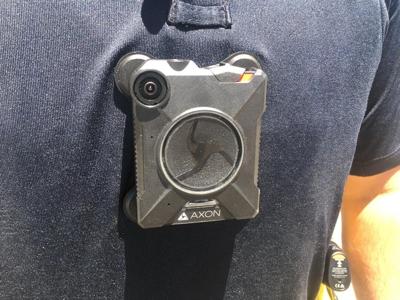
The Reno and Sparks Police Departments and the Washoe County Sheriff's Office began using body cameras, Monday. Some officers even started using them on the overnight shift, Sunday night.
The move comes three weeks before the new state law requires certain uniformed officers to wear the devices. Officers say it adds another layer of accountability and transparency.
"You'll be able to hear what people are saying and you'll be able to get a little bit of an understanding of what the officer is facing in any given situation," Officer Ken Gallop, Sparks Police Department said.
The cameras are smaller than most cell phones, and mount to the officer's chest. The cameras are on throughout each officer's shift. When he or she is called to an incident, call or even a traffic stop, they begin recording.
"When I receive a call for service, I can go ahead and I'm just going to double tap it and it's going to indicate with a blinking red that it's now recording," Officer Travis Warren, Reno Police Department said.
At the end of each shift, the officers load their footage onto a server. If an RPD officer forgets to record an event, the officer has to document why the camera was not recording. It is also very difficult for a camera to stop recording during an incident.
"To avoid any accidental deactivation of the cameras, you have to hold the button back down for about four seconds," Warren said.
Technology also allows a secondary way to activate the cameras. When an officer turns on his Taser, it will send a signal to every officer's camera in the immediate vicinity, instantly telling the cameras to record.
Warren says since cameras are found almost everywhere, including on phones, in the media and in the court system, it makes sense for cops to have them, too.
"Everybody expects things to be videotaped now," Warren said. "So this provides that video recording so that if things come in, they can revert to the camera footage to see."
All three agencies are using the Axon system, making it easier for investigations from one agency to another. Gallop says the officers do not have access to the video and it cannot be tampered with. All the officers do is load it, name it, and give it an incident number and case report number. The officers have been training on the new system and they are using the next three weeks to work some of the issues out.
"There will be a bit of a learning curve, I'm sure," Gallop said. "I'm sure there will be a couple mistakes along the way but nothing that we can't overcome."
The cameras do have an option that allows officers to mute the audio during sensitive situations but video is still recording. There is also a 30-second buffer that is saved once the device starts recording. Gallop says the cameras could be very useful but says there are some limitations.
"It certainly wouldn't capture everything if I look to my left or look to my right, so we understand those limitations.," Gallop said. "We get it but having this audio and video recording, I think, is a tremendous asset."
SPD already has an in-car camera system. It is changing those cameras to match with the Axon system. The cameras can be loaded onto the server on a docking device at the police station but officers can also upload it into their car's system, which goes to the same server.
People can view the video but the proper steps vary depending on which agency they are dealing with. The video is considered a part of public record, so citizens can access it like any other police reports.