Cities across Nevada are feeling the negative impacts of four dry winters. Perhaps none have it as bad as the farmers in Lovelock.
"As far as I know, we're the worst in the state," Bennie Hodges, Secretary Manager of the Pershing County Water Conservation District said. "I can't think of anybody that does flood irrigation in any kind of irrigation district that's worse than we are."
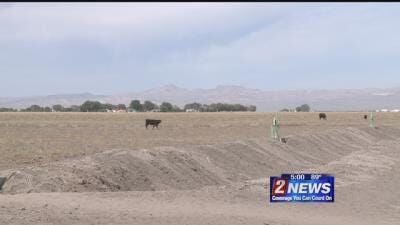
Two years ago, the small town only received 10% of its water allocation. For the past two summers, they have not received any water to irrigate their fields. No water means no crops. So most farmers haven't planted for more than three years.
Mike Phillips is a long-time farmer at Nevada Nile Ranch, south of Lovelock. He says he has never seen such a devastating drought.
"Typically, on a normal year, we'll put up 27,000 tons and we've put up zero hay this year," Phillips said.
Phillips says ranches have been forced to lay farm workers off, including 22 at Nevada Nile Ranch. The ripple-effect has been felt through town. The population is shrinking and revenue is decreasing. Mayor Mike Giles says the city has been innovative in finding ways to save money by receiving federal grants and cutting costs. Luckily, they haven't had to cut staff, but he says water is needed to revive the local economy.
"We're going to reach a point, here, where something is going to have to give," Giles said. "We either get water and get employees back in or we'll have to cut services."
Lovelock farmers rely on water storage at the Rye Patch Dam, on the Humboldt River. The reservoir will hold up to 200,000 acre feet of water but it is currently only 5% of capacity. Snowfall in the Ruby Mountains has been too light to recharge the river and the reservoir.
"We are trying to make a living on the bottom end of one of the most meager stream systems in the driest state in the nation," Hodges said.
The infrastructure that makes the valley's agriculture possible, also requires maintenance.
"It's frustrating," Hodges said. "We have to stay and operate and these guys have to pay us a salary and operate the district. Yet, we're not seeing any of them receive any income for their labors, and basically, it's been like this for the last three years."
After three years, many of Lovelock's fields are withering away. Some ranchers have put their cattle on alfalfa fields for grazing, since the crop is too thin to harvest. Some farmers are plowing their fields to prepare them for next year and to prevent wind erosion. Unfortunately, the summer rain has not helped either. Phillips says he has already sprayed weeds in irrigation ditches, four times.
"Our weed budget has tripled, this year," Phillips said. "Weeds just keep coming. Every time we get a rain, another batch of weeds."
Most of the area's farmers do have crop insurance but it does not make up for more than two years of lost production. Some farmers are in danger of losing their insurance because a viable crop is needed to qualify. The drought is wiping many of those crops out. All they can do is plan for better days.
"A lot of work, a lot of diesel, a lot of tractor work for us," Phillips said. "With 7,500 acres, we can't do it overnight. So, we're starting early on a gamble that we will have water, next year."
Some of that work includes clearing irrigation canals that have been dry for more than two years, overgrown with weeds. That growth will have to be removed in order for the ditches to be operational again.