
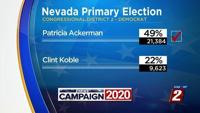

UPDATE: Democrat Patricia Ackerman has won a seven-candidate contest in a northern Nevada congressional district.
Results released Thursday show Ackerman defeated former Obama administration official Clint Koble, former journalist Ed Cohen, retired business owner Rick Shepherd, Reynaldo Hernandez, Ian Luetkehans and Steve Schiffman in Tuesday’s primary election.
Ackerman, a retired mountaineer and former actress, will face a steep challenge in November against Republican Mark Amodei.
Amodei since 2011 has held the 2nd Congressional District, where Republicans hold a strong voter registration advantage over Democrats.
----
Nevada's 2020 primary election is over but the ballots are still being counted. The election was mostly done by mail, and officials say that was a big factor in voter turnout.
"We're definitely going to set a record for turnout," Wayne Thorley, Nevada Deputy Secretary of State for Elections said. "I anticipate when all is said and done, we'll be somewhere in the range of 420,000 ballots cast for this primary election. For comparison, two years ago in 2018, there was 330,000."
As of Wednesday, Nevada's voter turnout was 27 percent. It was about 20 percent in the 2018 primary election. Washoe County's voter turnout was 32 percent with many more ballots expected. The Washoe County Registrar's Office received 12,000 mail-in ballots, Wednesday.
"It looked like yesterday and today's ballots that we received really has increased the number of voters who have cast their ballots in this primary election," Deanna Spikula, Washoe County Registrar of Voters said.
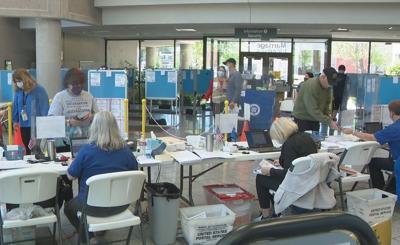
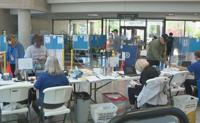
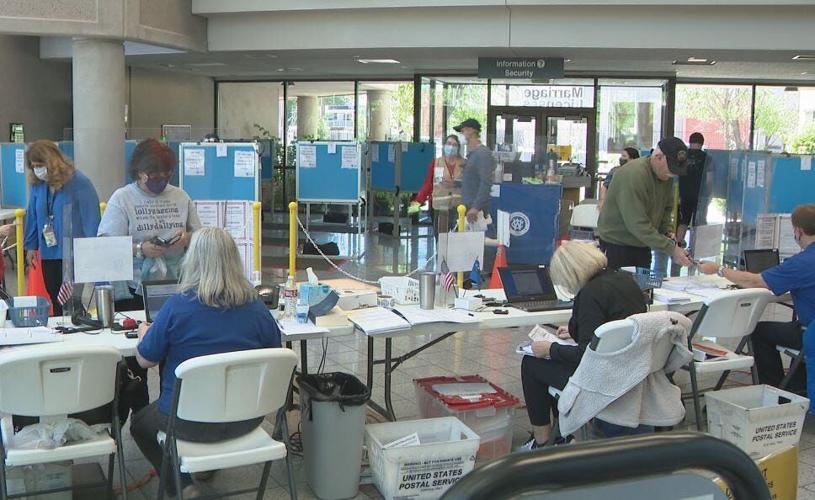
Nevada's election was mostly done through the mail. Each county had one in-person polling location except Clark County, which had three. They reduced the numbers to prevent exposure of COVID-19. The lack of voting locations led to long lines in some places. Some Washoe County residents waited in line for at least an hour-and-a-half. Lines lasted for more than three hours in Clark County.
"I walked the line many times throughout the day. They seemed to be in good spirits for the most part." Spikula said. "We wish we could accommodate a less than 30-minute wait for every location, every election, but unfortunately that's just not realistic."
Nevada's democrats blamed the Secretary of State's Office for the long lines because of the plan to reduce polling locations.
“The disaster that was hours-long wait times and Nevadans voting well past midnight on election night are the exact problems we worked to avoid," William McCurdy II, Nevada State Democratic Party Chair said. "These problems were entirely avoidable by the Secretary of State."
Each county is actually in charge of the number of voting locations. Most chose to have one but they had the ability to open more if they wanted to. Also, voting in-person was optional since every registered Nevadan should have received a ballot in the mail.
"The majority of voters that were voting in-person simply just chose to vote in-person because the didn't want to vote by mail," Thorley said. "So the big turnout wasn't a result of people needing to be there. It was people wanting to be there."
Thorley says approximately 98 percent of all ballots were done through the mail. Current events like COVID-19 and civil rights protests are possible motivators but he says the convenience of voting by mail was also big factor.
"Other states that have made the switch to voting by mail, primarily all-mail elections have all seen an increase in turnout," Thorley said.
The higher numbers also come during an election year that does not have any high profile races, including statewide and U.S. Senate seats.
There are some new laws that took effect on January 1 regarding elections. One of them allows people to register to vote on the day of the election.
"We didn't see too many new registrations again in-person, yesterday, but of course conditions are unique for this election," Spikula said.
Since the general election will be a more traditional election, where most people vote in-person, same-day registrations could be more of a factor in November. The law also requires seven days for a vetting process. It is a safeguard to cross reference new registrations to make sure someone is not registering in multiple counties. It also allows time for mail-in ballots to arrive that are postmarked on election day.
Another new law requires automatic voter registration at the DMV. Officials say numbers grew in January and February but the closure of the DMV because of the pandemic brought those to a halt. Thorley says new registrations in April were 85 percent lower than those in February. Spikula says about 30 percent of them are new voters and the rest are updated registrations. We can expect a lot more by November.
"The DMV is gearing up for reopening next week, so really anticipating an increase in the number of voters that are registering to vote," Thorley said.