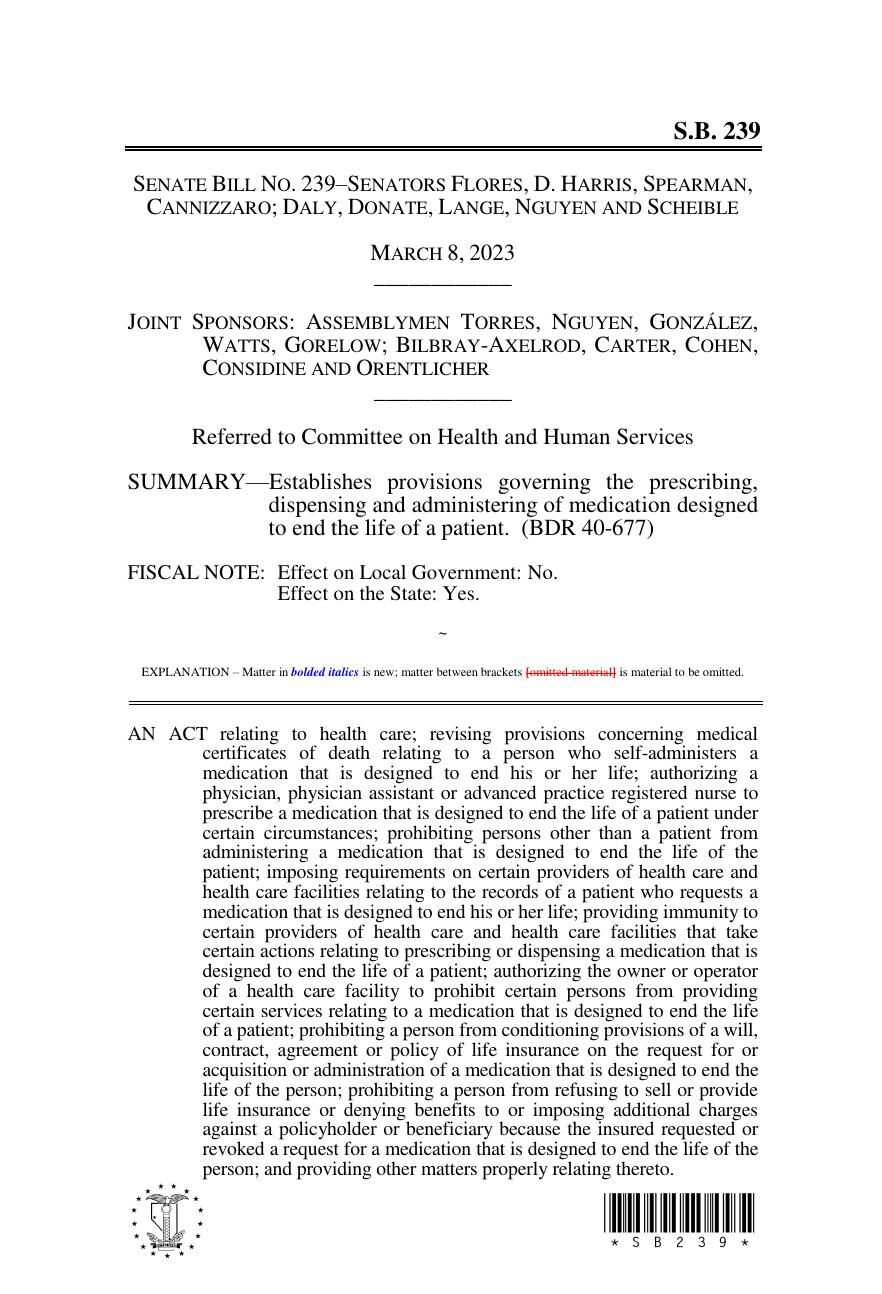




Senate Bill 239 creates a path for terminal patients to end their own lives without requiring medical professionals to participate.
The drug would only be administered by the patient and only after several steps to show they have a terminal condition and they are mentally competent to make the decision.
The hearing generated dialogue regarding both pragmatic and philosophical questions about life, death, and free choice.
Democratic Las Vegas Senator Edgar Flores opened the hearing with a caveat - everyone should be incredibly respectful of everyone's position.
In testimony, Senator Flores told the Nevada Senate Health and Human Services, he had felt differently six years ago, but then changed his mind when a family member was terminally ill and suffering.
"How much suffering is too much and when we talk about suffering who is deciding that? Is it we the family forcing the family to suffer up to the very last breath to serve our own egotistical desire to keep that individual for that additional second regardless of how painful that moment may be for that individual,” said (D) Las Vegas Senator Edgar Flores.
Past legislative efforts have approached the matter as a "dignity in death" issue, but typically had physicians administering the fatal drug.
SB-239 instead takes the matter out of doctors' hands.
Among the requirements the patient must be 18 or older. The terminal diagnosis must be made by two medical practitioners. The patient must be mentally competent.
The law requires the patient to make two verbal requests and a written request signed by a witness.
One argument by opponents of the issue is that terminal death prognoses are subjective.
SB-239 instead takes the matter out of doctors' hands, and into terminally ill patients.
"You are not deciding between living and dying, you're deciding in controlling your own fate,” said Flores.
UNR Professor of Medicine and Director of Academic Hospitalists Kirk Bronander argues the legislation could open the door to patients ending their lives prematurely.
"The prognostication of when a person will live six months with a terminal illness is subjective. It's very difficult to know how long someone will live in the final days, weeks, months of an illness. Study after study done on the prognostication of illness has proven this. My own father was diagnosed with Glioblastoma and given six months to live. And lived for almost four years."
Reno Psychiatrist Dr. Barry Cole says the bill is flawed for two major legal reasons.
“What do you do with the man with Locked-in Syndrome? What do you do with the cervical cord injury. How does he or she self-administer. It's already discriminatory on its face. Secondly, you've mistaken competence for capacity, as a psychiatrist, I determine capacity. I have no say about competence. That's assumed to exist until a judge takes it away from someone,” said Dr. Barry Cole.
Opponents also say it will draw people from out-of-state to come to Nevada to administer their own suicides.
The specific drug that patients would self-administer has not been named in the legislation.
Text of the bill here: