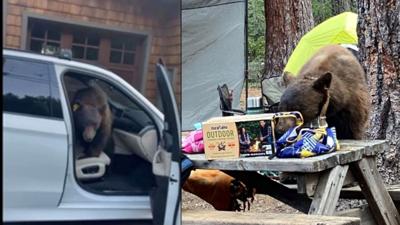
A conflict bear that repeatedly broke into cars, homes, and campsites in the Lake Tahoe Basin was euthanized last week by the California Department of Fish and Wildlife.
On the evening of July 7, CDFW biologists and wildlife officers responded to a report of a bear causing extensive damage to an unoccupied home in the Meeks Bay area of South Lake Tahoe.
The bear, identified by an ear tag numbered 717, was found inside the residence and immediately recognized by staff.
According to CDFW, the bear had been captured, tagged, and relocated in 2021 following a series of break-ins involving both residential and commercial property.
Despite being moved to a wild habitat, the bear returned to the area and resumed conflict behavior, including entering cars, damaging businesses, and charging at campers in attempts to access food.
DNA had previously been collected from the bear, and CDFW had attempted to haze it away from populated areas multiple times over several years. The bear had become “trap shy,” meaning it avoided capture despite repeated efforts by staff.
Based on the bear’s continued property damage and risk to public safety, CDFW authorized lethal removal. When the bear was clearly identified on July 7 by its ear tag, it was euthanized.
CDFW said the bear weighed close to 400 pounds and had severely rotted teeth, a condition often seen in bears that consume human food and garbage.
The agency collected the bear’s skull for scientific and educational use, and its remains were returned to the forest to decompose naturally. The carcass was later relocated to minimize potential encounters.
This action, CDFW stated, highlights the importance of keeping bears wild by preventing access to food and trash.
The agency’s approach to black bear management prioritizes nonlethal methods such as hazing, eliminating attractants, and bear-proofing property.
CDFW continues to monitor California’s black bear population using GPS collars, DNA collection, camera traps, and other tools outlined in its recently updated Black Bear Conservation and Management Plan.
More information about living responsibly with bears is available on the BearWise website.