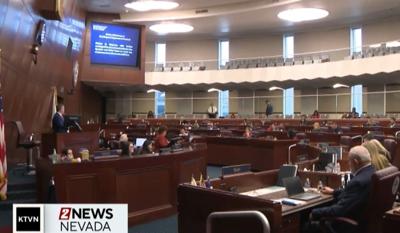



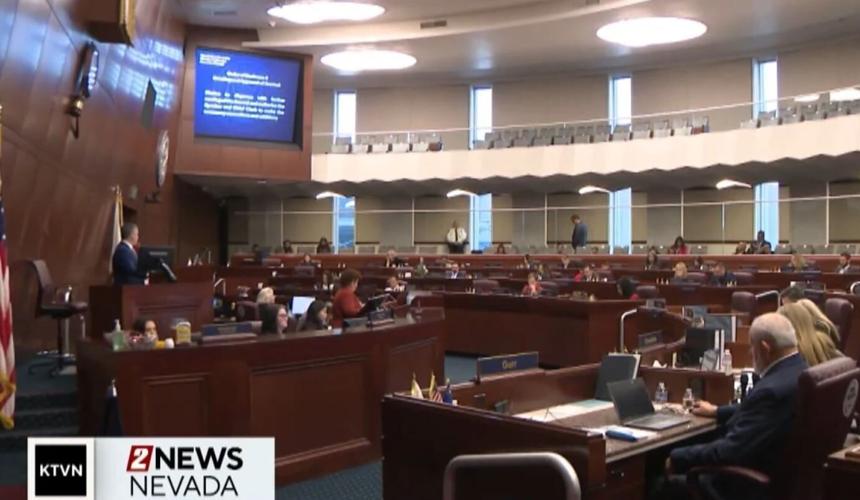
There was not much movement on Monday in the Nevada Legislature.
Early in the morning on the Senate floor, Assembly Bill 5, the film tax credits bill, had a second reading.
The Assembly moved through a couple of bills as well, but left several still on general file.
The legislation that's looking to give Warner Bros. Discovery and Sony Pictures Entertainment $1.8 billion in transferable tax credits over 15 years awaits a floor vote in the Senate chambers.
Since day one, there's been fireworks between Assembly Democrats over this bill.
Like the Assembly, the Senate is a Democratic majority, but this is an issue that crosses partisan divides.
"This is one of those interesting sorts of issues that there's no like party line sort of alignment," said Assem. Reuben D'Silva, (D) Clark County. "You have Republicans who are in strong support, Democrats and strong supportive Republicans, and strong opposition Democrats and strong opposition Republicans. It's just one that I think that people feel very passionate about."
Those who oppose it are worried about what the long-term future holds.
"I have a lot of concerns just about where we're going to be as a state, and what state revenues look like come 2030, 2031," said Assem. Blayne Osborn, (R) District 39. "If the film tax credits go through, and what the performance of the studios will look like."
Others who champion the bill think it'll provide great job opportunities and diversify the state's economy, which relies on gaming and tourism.
The Assembly narrowly passed the bill 22-20 on Sunday.
There's been a lot of talk about legislators voting remotely, especially with two lawmakers, Assem. Brian Hibbetts, (R) Clark County, and Assem. Heidi Kasama, (R) Clark County, voting through Zoom on that bill during the floor hearing.
"I believe one of them was going to Cabo and one of them was headed to Europe, and that was deemed an extreme circumstance," said Assem. Brian Koenig, (R) District 38. "So, I think we've set the bar pretty low at this point."
Koenig says he believes the decision to remote vote creates a bad precedent.
The two were marked as an excused absence on Monday, so they did not vote then.
The two Assemblymembers voted 'yes' on the film tax credits.
Koenig believes this is why they were given the luxury.
"What if someone who was on the opposing side wanted to Zoom in? Would they be afforded that same exception? I don't know, I just think it's a bad precedent," he said.
Some critics have cited that they are not letting public comment happen over the phone on the Assembly side.
Other Assemblymembers don't think it's as big of a deal.
"I think that if there's a situation where they need to be brought in, their duly elected representative, there could be a constituency they shouldn't be allowed to be able to vote remotely," D'Silva said.
We reached out to Assembly Democrats to speak with Assembly Speaker Steve Yeager. We received a statement. In it, Yeager said he has done this in the past.
He said since it's a part-time legislature, he likes to give Nevadans a chance to hear from their elected representatives to see how they vote.
We waited outside his office to ask more questions and get further clarification, and he refused to provide comment other than the statement.