





Loggerhead sea turtles laid a record 4,292 nests on Georgia beaches this year, a hard-won rebound from a low of 358 nests in 2004.
Loggerhead moms do the bulk of the work here, of course. But they get oversight and protection from a team of hundreds of volunteers and professionals who fan out on beaches from Cumberland to Tybee nearly every day from May through August. The effort is even more intense on Wassaw Island where rotating groups of ecotourists stay up all night to document the turtles that nest at this national wildlife refuge.
A crew from The Current GA set out to document this labor of love, spending the night on Wassaw, babysitting Tybee nests that stubbornly resisted hatching, and walking the Tybee beach at sunrise.
Dawn patrol
Job number one is find the nests at dawn after turtles have laid them overnight. Alli Caldwell, programs director at the Tybee Island Marine Science Center, patrols the beach frequently. The science center oversees the Tybee Island Sea Turtle Project, which like all the Georgia sea turtle monitoring, is run under the direction of the Department of Natural Resources’ loggerhead guru Mark Dodd.
On July 2, Caldwell surveyed the southern half of Tybee beach, setting off before dawn and scanning the sand for the telltale sign that a loggerhead mama had lugged itself up the beach to lay its eggs and then returned to the sea: a looping track that resembles a single heavily treaded tire.
It was the height of the summer season and by 6:30 a.m. a couple dozen tourists lounged on the beach near the pier. Still no tracks in sight, Caldwell doublechecked an already recorded nest marked by caution tape, a printed sign and screening atop the sand to discourage predators and overly curious beachgoers.
All good. She noted ghost crab tracks on several nests and a hole from a ghost crab at one, but no serious predation. With 41 nests recorded by July 2, Tybee had already shattered its previous record of 35 nests set four years ago. The loggerheads were so prolific that the science center had to order more nest-marking supplies, ending the season with 59 sea turtle nests.
And beachgoers are more informed than ever. On Tybee, one young woman noted Caldwell’s sea turtle volunteer shirt and congratulated her on the record number of nests.
As Caldwell scouted the southern end of Tybee, Science Center board member Tim Mescon and his wife Lauren scoured the northern half of the island this day, also on foot, leaving no part of the 5-mile beach unscrutinized.
Loggerheads take a long time to grow up, only beginning to nest when they’re about 25-30 years old. So the turtles nesting this year owe their existence to protections begun before the turn of the century. That includes the introduction of turtle excluder devices that prevent turtles from drowning in shrimp nets as well as this extensive beach monitoring, a program in place coastwide since 1989.
Night vigil
On Wassaw Island, the action begins after sunset, when sea turtles nest. Savannah-based Caretta Research Project recruits volunteers, each of whom pays to stay at the island’s rustic cabin for a week of working the night shift.
“It’s stifling heat, vicious bugs, and the humidity is awful,” sums up Caretta’s project director Kris Williams Carroll. “There’s no privacy, but the turtles are awesome.”
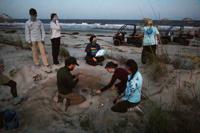
The project, named for the loggerhead’s Latin designation, Caretta caretta, is the longest continuously running saturation tagging program in the U.S. It’s in its 54th year. At about 8 p.m. on a sweltering night in July, Carroll hopped in her Kawasaki mule to scour the beach for nesting turtles. She sent her deputies and volunteers in the other direction, all the better to cover the island’s seven miles of pristine beach.
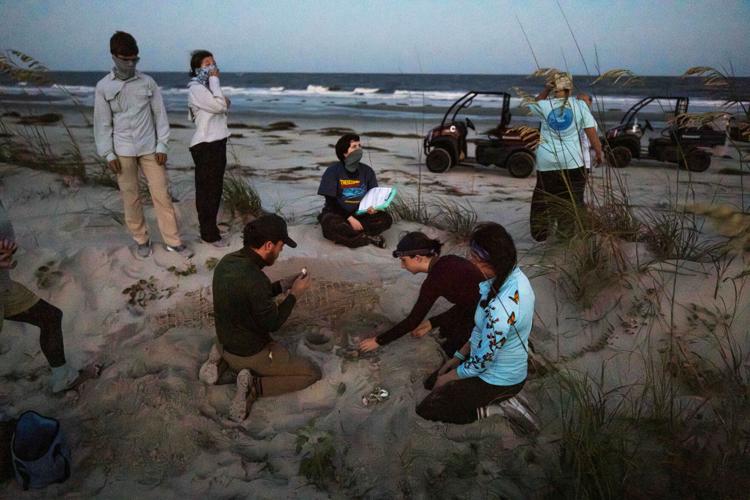
Carroll headed first to a nest that hatched three days prior, the first hatch of the season. It’s a process repeated up and down the coast for every nest that emerges.
“Oh my gosh, they were right up on top,” Carroll said as she removed the screening and brushed away sand to reveal three wriggling hatchlings that failed to emerge with their siblings.
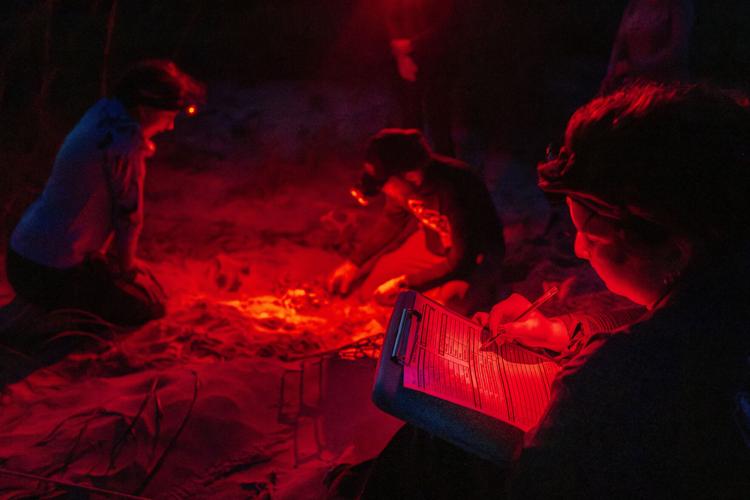
Setting the stragglers aside temporarily, Carroll counted the unhatched eggs, eggshells and live hatchlings to determine nest success. She also snipped off a sliver of tissue from the front flipper of several dead hatchlings for genetic testing at the University of Georgia. Research scientist Brian Shamblin’s lab there has been testing loggerhead eggs for maternal DNA since the mid-2000s and has created a robust database of the adult female loggerhead population. Now he’s begun tracking males, too, using both DNA from the dead hatchlings as well as DNA from one egg from each nest.
Like the dawn patrollers, Carroll looks for tracks, but because it’s nighttime she’s also watching for female sea turtles making their way across the beach.
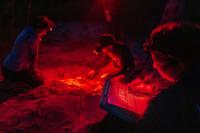
Less than an hour into patrols, one team spots a meterlong loggerhead digging her nest at the southern tip of the island. The turtle has wedged against a foot-high cliff of sand. She digs alternating left and right back flipper throwing sand outwards as she does. Laying eggs puts her in a trancelike state.
Caretta’s lead biologist Jadyn Sethna removes one egg, still slick with mucus, for genetic testing. A scan of the turtle’s flippers reveal a PIT tag – like the kind used to identify pets. The internal tag along with a metal flipper tag reveal her to be a turtle named Mia (after the daughter of a friend of Carroll).
Once Mia starts laying it goes quickly. Since she’s already laid nests this season on Wassaw – loggerheads typically lay three or four nests per nesting season every two to three years – there’s less work to do on her. Mia camouflages her nest by scattering sand with her flippers, paying little mind to the people gathered around her.
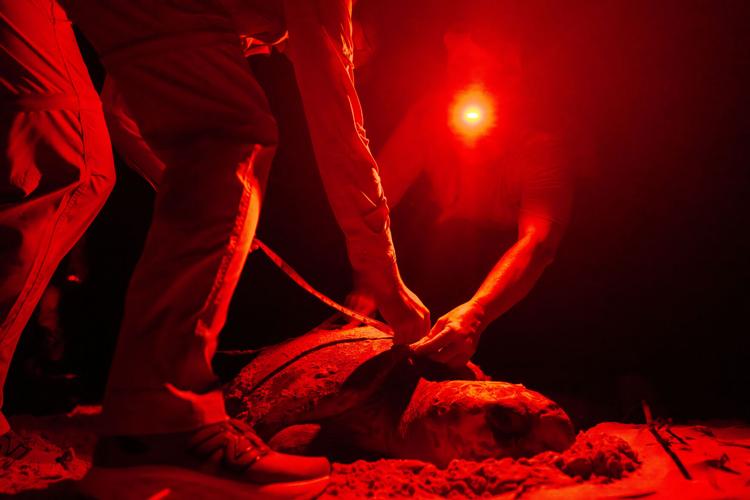
Sethna rubs a hand against Mia’s shell to brush off sand before she measures the turtle’s length and width. As she does, algae on the shell glows with bioluminescence.
When Mia’s finished laying she makes her way to the surf, rocking side to side on flippers made for swimming but pressed into more awkward service on the beach.
The second nester of the night lands further north. What looks like a shark bite on the back of her shell has healed and doesn’t seem to bother her. She’s a thinner shape than Mia, but about the same length.
She has no tag, so the team gets to work injecting a PIT tag. They then clamp a metal tag to her front left flipper and record the tag numbers. They also take skin samples from her shoulder area for DNA analysis. This turtle, too, donates an egg to the ongoing DNA analysis.
Welcome, hatchling
On some parts of the Georgia coast, including Tybee Island, volunteers and professionals babysit turtle nests that are about to hatch.
That’s what put Tyler Hood, an aquarist with the Tybee Island Marine Science Center, at nest #26 about 50 days after it was laid on June 8. A bowl-shaped depression on the top of the nest indicated movement below and an impending hatch.
When she arrived near sunset at the nest south of Gullick Street, Hood found a dead hatchling poking out of the nest. It had emerged in daylight, a fatal mistake, and its front flipper got entangled in tiny plant roots from a nearby dune, leaving it exposed to the hot sun.
Hood popped it into her shirt pocket for later genetic testing.
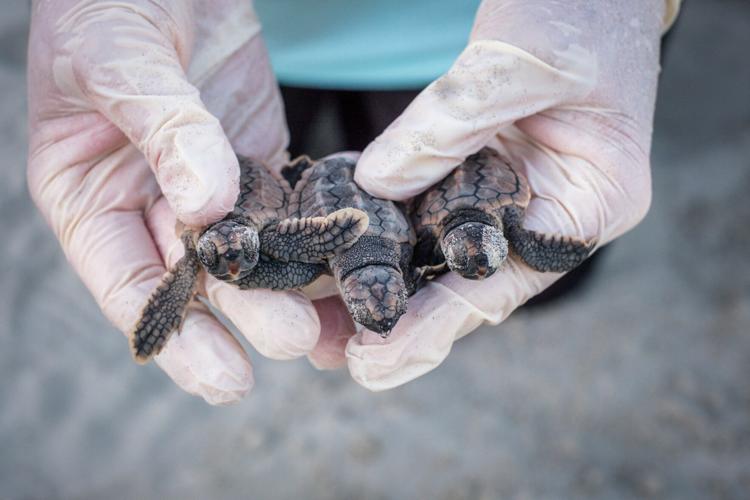
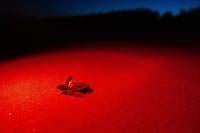
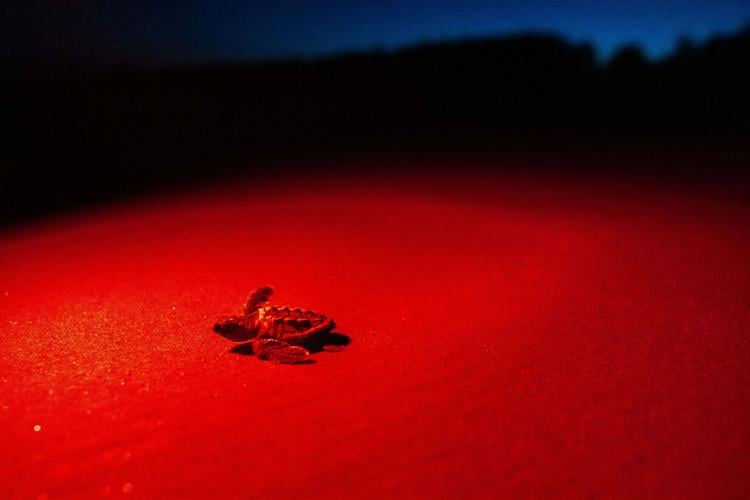
Minutes later, she saw another hatchling, this one very much alive.
“That’s a head. That’s a little baby sea turtle head,” she said. “It just hatched.”
The tiny turtle struggled through a maze of grasses, flopping over, righting itself and eventually making his way to open beach and the water.
It turned out to be the only hatchling to make it out of the nest as Hood watched. Rain drove her and the other onlookers inside. That means Hood missed the “boil” which is when the majority of the more than 100 hatchlings in a typical nest scramble out of the nest in quick succession.
So did a team from The Current GA, which tried that night and three others to witness a nest boil, staring at the sand atop a ready-to-hatch nest for hours to no avail.
That’s not surprising, said Dodd, the state’s sea turtle program coordinator. The hatchlings typically boil out at nighttime when no one is on the beach, even a popular one like Tybee.
“If you get to see it you’ve seen a really rare thing,” he said.
This story was originally published by The Current and distributed through a partnership with The Associated Press.