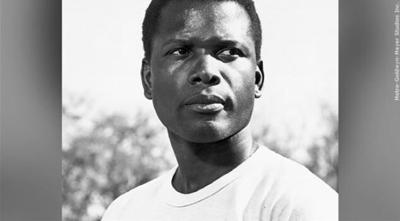



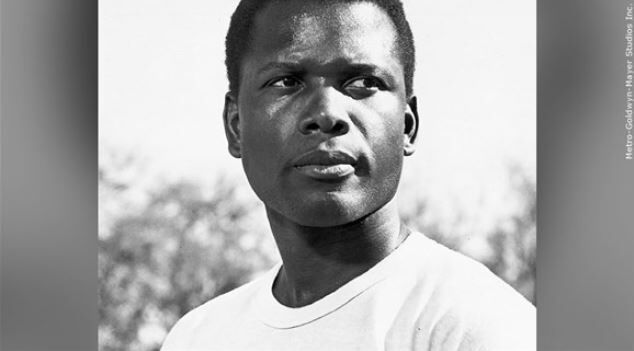
Legendary actor Sidney Poitier has died at 94.
Poitier was the first Black and first Bahamian man to win an Academy Award for Best Actor in 1963's Lilies of the Field and an Honorary Award in 2001.
Few movie stars, Black or white, had such an influence both on and off the screen. Before Poitier, the son of Bahamian tomato farmers, no Black actor had a sustained career as a lead performer or could get a film produced based on his own star power. Before Poitier, few Black actors were permitted a break from the stereotypes of bug-eyed servants and grinning entertainers. Before Poitier, Hollywood filmmakers rarely even attempted to tell a Black person’s story.
Poitier’s rise mirrored profound changes in the country in the 1950s and 1960s. As racial attitudes evolved during the civil rights era and segregation laws were challenged and fell, Poitier was the performer to whom a cautious industry turned for stories of progress.
He was the escaped Black convict who befriends a racist white prisoner (Tony Curtis) in “The Defiant Ones.” He was the courtly office worker who falls in love with a blind white girl in “A Patch of Blue.” He was the handyman in “Lilies of the Field” who builds a church for a group of nuns. In one of the great roles of the stage and screen, he was the ambitious young father whose dreams clashed with those of other family members in Lorraine Hansberry’s “A Raisin in the Sun.”
Poitier peaked in 1967 with three of the year’s most notable movies: “To Sir, With Love,” in which he starred as a school teacher who wins over his unruly students at a London secondary school; “In the Heat of the Night,” as the determined police detective Virgil Tibbs; and in “Guess Who’s Coming to Dinner,” as the prominent doctor who wishes to marry a young white woman he only recently met, her parents played by Spencer Tracy and Katharine Hepburn in their final film together.
Theater owners named Poitier the No. 1 star of 1967, the first time a Black actor topped the list. In 2009 President Barack Obama, whose own steady bearing was sometimes compared to Poitier’s, awarded him the Presidential Medal of Freedom, saying that the actor “not only entertained but enlightened ... revealing the power of the silver screen to bring us closer together.”
The only Black actor before Poitier to win a competitive Oscar was Hattie McDaniel, the 1939 best supporting actress for “Gone With the Wind.” No one, including Poitier, thought “Lilies of the Field” his best film, but the times were right (Congress would soon pass the Civil Rights Act of 1964, for which Poitier had lobbied) and the actor was favored even against such competitors as Paul Newman for “Hud” and Albert Finney for “Tom Jones.” Newman was among those rooting for Poitier.
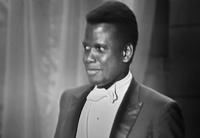
When presenter Anne Bancroft announced his victory, the audience cheered for so long that Poitier momentarily forgot his speech. “It has been a long journey to this moment,” he declared.
When Denzel Washington became the second Black man to win best actor in 2002, he thanked Poitier in his acceptance speech.
Forty years I've been chasing Sidney, they finally give it to me, what'd they do? They give it to him the same night. I'll always be chasing you, Sidney. I'll always be following in your footsteps. There's nothing I would rather do, sir. Nothing I would rather do. God bless you. God bless you.
Earlier in the night, Poitier was awarded an honorary Academy Award.
Poitier had four daughters with his first wife, Juanita Hardy, and two with his second wife, actress Joanna Shimkus, who starred with him in his 1969 film “The Lost Man.” Daughter Sydney Tamaii Poitier appeared on such television series as “Veronica Mars” and “Mr. Knight.”
Poitier, who held dual U.S. and Bahamian nationality, was "an icon, a hero, a mentor, a fighter, a national treasure," Deputy Prime Minister Chester Cooper said on his official Facebook page (below).

(The Associated Press, CBS News contributed to this report.)