







Today, Nevada State Treasurer Zach Conine announced the Nevada Student Loan Ombudsman within the Treasurer’s Office will be working directly with borrowers to navigate their student loans after President Biden announced a new approach for student debt relief through the Department of Education.
“President Biden’s efforts to cancel up to $20,000 in federal student loans for borrowers would help hundreds of thousands of Nevadans escape from the crushing weight of student loan debt,” said Treasurer Conine. “While it’s unfortunate that the Supreme Court did not uphold the President’s initial proposal, my Office looks forward to working with our Congressional delegation and the Department of Education to help borrowers understand what options will be available to them going forward.
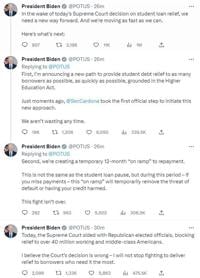
Today, the President announced a series of new actions that are being undertaken by the Department of Education to alleviate student loan debt, including:
1) New rulemaking consistent with the Higher Education Act of 1965, allowing the Secretary of Education to “compromise, waive, or release loans” under certain circumstances;
2) Finalizing an affordable repayment plan for student loans that is estimated to save borrowers more than $1,000 per year; and
3) Instituting a 12-month on-ramp for upcoming repayments, so that borrowers who miss monthly payments due to financial hardship will not be considered delinquent, reported to credit bureaus, placed in default, or referred to debt collection agencies.
According to the White House, over 315,000 people in Nevada were estimated to be eligible for the President’s initial debt relief program.
Prior to the program being challenged in the courts, 198,000 Nevadans who applied for the program were deemed to be eligible for student loan cancellation.
As more information on these new actions becomes available, Nevada’s Student Loan Ombudsman will be working directly with borrowers to help them understand what options may be available to them.
If borrowers have questions about their student loan payments, the Student Loan Ombudsman can be reached by emailing SLO@nevadatreasurer.gov or by visiting NVigate.gov
--------
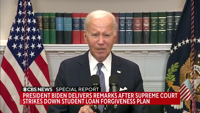
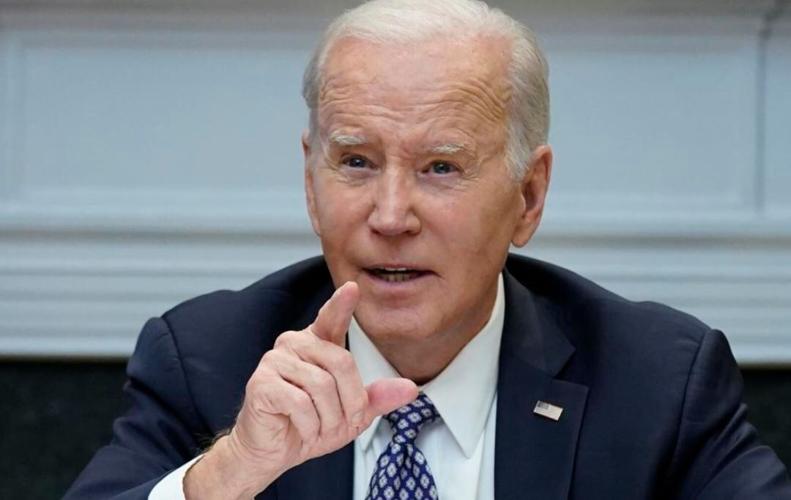
President Joe Biden is offering an alternative student debt plan designed to ease borrowers' threat of default if they fall behind on their payments, after the Supreme Court struck down his original initiative.
Biden on Friday blamed Republican opposition for triggering the Supreme Court's ruling and slammed the decision as wrong.
The president said he will work under the authority of the Higher Education Act to begin a new program that would begin loan repayment but remove the immediate threat of default. He said the plan would take longer but provide relief to millions of borrowers.
He had proposed a $400 billion plan to cancel or reduce federal student loan debts for millions of borrowers.

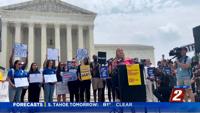
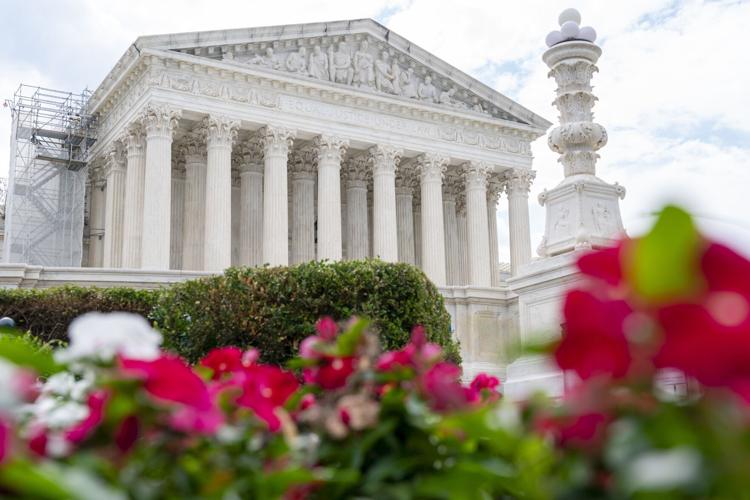
A sharply divided Supreme Court ruled Friday that the Biden administration overstepped its authority in trying to cancel or reduce student loans for millions of Americans.
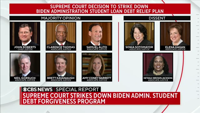
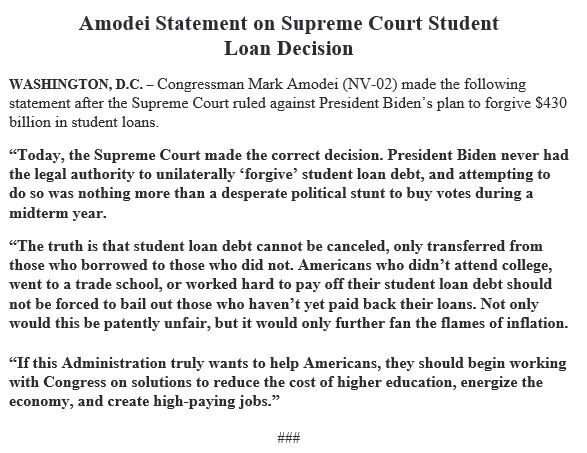
The 6-3 decision, with conservative justices in the majority, effectively killed the $400 billion plan, announced by President Joe Biden last year, and left borrowers on the hook for repayments that are expected to resume by late summer.
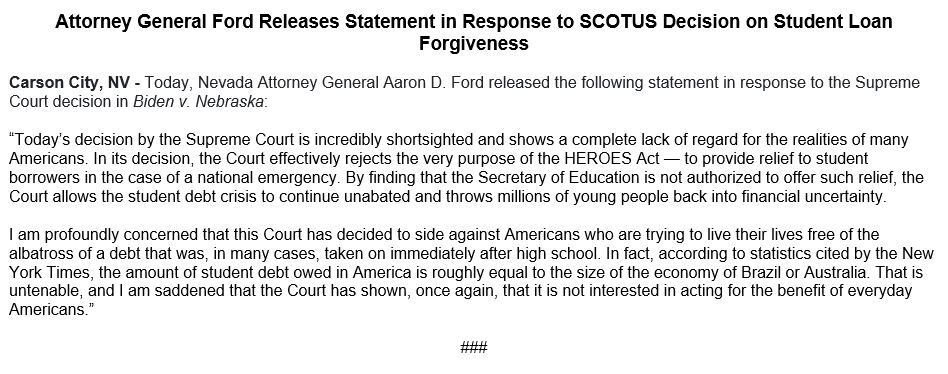
The court held that the administration needs Congress' endorsement before undertaking so costly a program. The majority rejected arguments that a bipartisan 2003 law dealing with student loans, known as the HEROES Act, gave Biden the power he claimed.
“Six States sued, arguing that the HEROES Act does not authorize the loan cancellation plan. We agree,” Chief Justice John Roberts wrote for the court.
Justice Elena Kagan wrote in a dissent, joined by the court’s two other liberals, that the majority of the court “overrides the combined judgment of the Legislative and Executive Branches, with the consequence of eliminating loan forgiveness for 43 million Americans.”
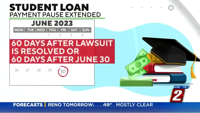
Loan repayments are expected to resume by late August under a schedule initially set by the administration and included in the agreement to raise the debt ceiling. Payments have been on hold since the start of the coronavirus pandemic more than three years ago.
The forgiveness program would have canceled $10,000 in student loan debt for those making less than $125,000 or households with less than $250,000 in income. Pell Grant recipients, who typically demonstrate more financial need, would have had an additional $10,000 in debt forgiven.
Twenty-six million people had applied for relief and 43 million would have been eligible, the administration said. The cost was estimated at $400 billion over 30 years.
(Copyright 2023 The Associated Press. All rights reserved. This material may not be published, broadcast, rewritten or redistributed without permission.)