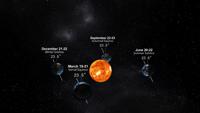
While it's already been hot enough for summertime activities for the past few weeks in Reno, the official start of summer begins Friday June 20th, at 7:42 p.m.
The earth is tiled at a 23.5-degree angle, and as the earth travels around the sun, the amount of direct sunlight we receive changes.
During the Summer Solstice, the Northern Hemisphere is pointed towards the sun, but during the Winter Solstice the Northern Hemisphere is pointed away. It is the reverse for the Southern Hemisphere.
We're actually a little bit further away from the sun on the summer solstice than the Winter Solstice. It's not equal because our orbit is not a perfect circle.
We see the most daylight on the Summer Solstice and the least amount of daylight during the Winter Solstice.

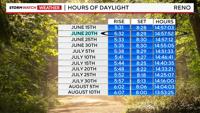
The sunrise will get later in the morning as the summer progresses, with sunsets getting earlier after Friday.
The sunrise in Reno on Friday will be at 5:32 a.m. with a sunset of 8:29 p.m.
By August 10th, Reno will have a sunset of 8 p.m.

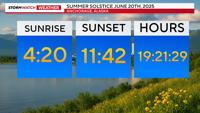
Regions closer to the North Pole experience more daylight than areas closer to the equator.
Anchorage, Alaska will have nearly 20 hours of daylight on the day of the Summer Solstice, while Reno will have almost 15. San Diego, California will see slightly less daylight than Reno.
Meteorological summer begins June 1, which is when the climate books start to show a warming trend. July and August are typically our hottest months, as it takes some time for the higher sun angles to correlate with hotter temperatures.
The ground absorbs the sun's radiation and then it is transmitted back into the atmosphere, heating the air.