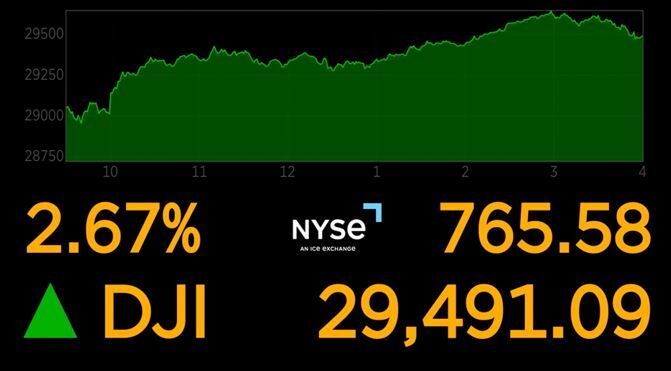


Wall Street rallied to its best day since late July as falling bond yields eased some of the pressure that’s battered markets.
The S&P 500 rose 2.6% Monday, the latest swing for a scattershot market that’s been mostly falling this year on worries about a possible global recession.
Treasury yields fell after a report on U.S. manufacturing came in weaker than expected.
That could mean the Federal Reserve won’t have to be so aggressive about raising interest rates to beat down the high inflation damaging households’ finances, but analysts still see plenty more turbulence ahead.
A report on U.S. manufacturing from the Institute for Supply Management came in weaker than expected. So did a separate report on construction spending across the country. While that may seem discouraging, it could mean the Federal Reserve won’t have to be so aggressive about raising interest rates in order to beat down the high inflation damaging households’ finances.
By raising rates, the Fed is making it more expensive to buy a house, a car or most anything else purchased on credit. The hope is to slow the economy just enough to starve inflation of the purchases needed to keep prices rising so quickly. But the Fed also risks causing a recession if it goes too far.
The Fed has already pulled its key overnight interest rate to a range of 3% to 3.25%, up from virtually zero as recently as March. Most traders expect it to be more than a full percentage point higher by early next year.
The yield on the two-year Treasury, which more closely tracks expectations for Fed action, fell to 4.12% from 4.27% following the weaker-than-expected reports on the economy.
Besides stocks, lower rates also boost prices for everything from cryptocurrencies to gold, which can suddenly look a bit more attractive when bonds are paying less in income.
Stocks of high-growth companies and particularly risky or expensive investments have been the most affected by changes in rates.
Still, cross currents continue to course through markets, and analysts largely expect sharp swings in prices to continue.
More turbulence for markets could arrive Friday, when the latest update on the U.S. jobs market hits. Along with its reports on inflation, the U.S. government’s monthly jobs report has been one of the most highly anticipated pieces of data on Wall Street.
It will be the last jobs report before the Fed makes its next decision on interest rates, scheduled for Nov. 2, and continued strength would give the central bank more reason to keep hiking. Traders say the likeliest move is a fourth straight increase of a whopping three-quarters of a percentage point, triple the usual move.
For markets to make a meaningful move higher, many investors say they need to see a break in inflation that gets the Fed to ease off its aggressive path.
Such hopes for a Fed “pivot” by investors have repeatedly resurfaced this year, only to get shot down by further accelerations in inflation.
But with stresses building in financial markets as central banks around the world hike rates in concert, conditions have gotten “into the danger zone where ‘bad stuff’ happens,” according to Michael Wilson, equity strategist at Morgan Stanley.
That could get the Fed to blink at some point. The problem, Wilson says, is that another force weighing on markets could soon come to the forefront: weaker corporate profits.
A suite of challenges from higher interest rates to the surging value of the U.S. dollar may be setting things up for “the freight train of the oncoming earnings recession,” he wrote in a report. Companies are getting ready now to report in upcoming weeks how they fared through the summer, and analysts have been downgrading their expectations.
(Copyright 2022 The Associated Press. All rights reserved. This material may not be published, broadcast, rewritten or redistributed without permission.)