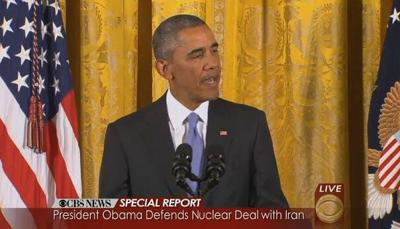
President Barack Obama is defending his high-stakes nuclear accord with Iran as a sign of American leadership that will make the world safer.
And he says that critics of the plan should consider the alternatives. The president says those who are criticizing the deal should stop and read the 100-page plan before objecting to it.
Second, Obama says critics should explain exactly why they think that the agreement won't keep Iran from getting a nuclear weapon - and why they know better than experts like his energy secretary, Ernest Moniz.The president also says critics of the plan need to come up with a better alternative to the deal. And he says that if their alternative is to rein in Iran through military force, they should be willing to say that.
Without the deal, he says, the world risks "even more war in the Middle East," increases the chances of an arms race, and leaves open the possibility of that Iran comes closer to having a nuclear weapon.
Obama spoke during an East Room news conference Wednesday, warning that the deal shouldn't be allowed to "slip away" because the opportunity "may not come again in our lifetime."
Here's a look at the agreement's main points:
-ENRICHMENT: Iran will reduce the number of uranium-enriching centrifuges it has from almost 20,000 to 6,104, and reduce the number of those in use from some 10,000 to about half that. Those limits will be in place for 10 years, then gradually relaxed over the next three. Iran also commits to using only its current models, rather than more advanced centrifuges it had wanted to install. Centrifuges spin uranium to concentrate it into levels that can range from reactor fuel to the fissile core of a nuclear weapon.
-STOCKPILE: Iran has already rid itself of stockpiled uranium that was enriched to one step from weapons-grade material. It is now committed to reducing its remaining stockpile - less-enriched uranium that is harder to use for nuclear arms - from about five tons to 300 kilograms (less than 700 pounds) for 15 years. U.S. officials say that at this level it would take Iran at least a year to enrich enough uranium for a nuclear weapon.
-UNDERGROUND SITE: Iran committed to convert its Fordo enrichment site - dug deep into a mountainside and thought impervious to air attack - into a research center. The site will still house centrifuges but they will make medical isotopes instead of enriching uranium, and there will be less than a tenth as many of them as there originally were.
-TRANSPARENCY: Iran will give more access to its nuclear program to the U.N. nuclear agency. If that agency identifies a suspicious site, an arbitration panel with a Western majority will decide whether Iran has to give the agency access within 24 days. All sites, including military ones, may be inspected if the agency has solid evidence of undeclared nuclear activity.
-REACTORS AND REPROCESSING: Iran must redesign its nearly built reactor at Arak so it can't produce plutonium for nuclear weapons.
-SANCTIONS: All U.S. and European Union nuclear-related sanctions will be suspended after experts have verified that Iran is hewing to its commitments. If at any time Iran fails to fulfill its obligations, those sanctions are supposed to snap back into place. An arms embargo will stand for five years and restrictions on Iran's ballistic missile programs for eight. Iran will get some access to currently restricted sensitive technologies. (AP)