President Donald Trump has condemned the "heinous" suspected poison gas attack in Syria and said he'll make a decision on the U.S. response within 24 to 48 hours.
Speaking in the White House Cabinet Room Monday, Trump vowed to find out who is responsible for the attack that reportedly killed at least 40 people.
Trump said during a Cabinet meeting with reporters that, "If it's Russia, if it's Syria, if it's Iran, if it's all of them together, we'll figure it out."
Opposition activists said 40 people died in the chemical attack late Saturday in the suburbs of the Syrian capital and blamed it on the Syrian government, which is closely allied with Russia.
Syria has blamed Israel for a missile attack on a central air base early Monday that reportedly killed 14 people, including three Iranians.
Since 2012, Israel has struck inside Syria more than 100 times, mostly targeting suspected weapons’ convoys destined for the Lebanese militant group Hezbollah, which has been fighting alongside Syrian government forces.
Most recently, Israel hit the same T4 base in February, after it said an Iranian drone that had violated Israeli airspace took off from the base. The base, which was used as a launching pad for counter offensive attacks against Islamic State militants who were at one point stationed close by, is near the Shayrat air base, which was targeted by U.S. missiles last year in response to a chemical weapons attack.
Israel’s foreign ministry had no comment when asked about the accusations.
Rami Abdurrahman, the Observatory’s chief, said the assault targeted a mobile air defense unit and some buildings inside the air base. He added that it also hit posts outside the base used by the Iranians and Iran-backed fighters.
Israel fears Iran could use Syria’s territory to stage attacks on it. The U.S. launched several dozen Tomahawk cruise missiles at a Syrian air base last year, after a chemical attack in the northern Syrian town of Khan Sheikhoun killed dozens of people.
WATCH: "We are studying that situation extremely closely. We are meeting with our military and everyone else that will be making some major decisions over the next 24 to 48 hours," @POTUS says on suspected chemical attack in Syria https://t.co/6qtRYVxltI pic.twitter.com/zmgQSS3GPG
— CBS News (@CBSNews) April 9, 2018
Saturday’s suspected poison gas attack on the besieged town of Douma came almost exactly a year after the U.S. missile attack prompted by the Khan Sheikhoun deaths.
In response to the reports, President Trump on Sunday blamed Syrian government forces for what he called a “mindless CHEMICAL attack.” In a series of tweets, President Trump held Russia and Iran, Syrian President Bashar Assad’s chief sponsors, responsible.
The Syrian government denied the chemical weapons allegations, calling them fabrications.
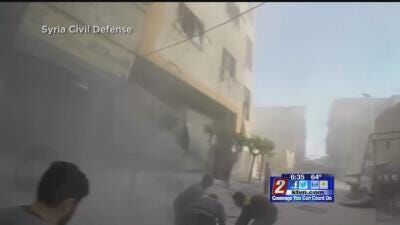
First responders entering apartments in Douma late Saturday said they found bodies collapsed on floors, some foaming at the mouth. The opposition’s Syrian Civil Defense rescue organization said the victims appeared to have suffocated.
The organization, also known as the White Helmets, and the Syrian American Medical Society, a medical relief organization, did not identify the substance used but said survivors treated at clinics smelled strongly of chlorine.
Those reports could not be independently verified because of a government blockade around the town.
Hours after the attack, the Army of Islam rebel group agreed to surrender the town and evacuate their fighters to rebel-held northern Syria, Syrian state media reported. The group also agreed to give up its prisoners, a key government demand.
The government agreed to halt its assault after three days of indiscriminate air and ground attacks.
More than 100 buses entered the town on Sunday night to take the fighters and their families to Jarablus, a town under the shared control of rebels and Turkey, said Syrian state-affiliated al-Ikhbariya TV.
Syrian state TV said two buses left early Monday and that 11 more buses were getting ready to move.
Syrian state media said dozens of civilians who had been held for years by the rebels were set free. The SANA news agency said the people were freed around midnight on SundayPresident , adding that they had been held by the Army of Islam group since 2013.
The evacuations follow a pattern of departures around the capital, Damascus, and other major Syrian cities as the government reasserts its control after seven years of war.
Human rights groups and U.N. officials say the tactic amounts to forced displacement, a war crime. The U.N. Security Council planned to hold an emergency meeting Monday to discuss the chemical attack.
In his tweets Sunday, President Trump called Assad an “animal” and delivered a rare personal criticism of Russian President Vladimir Putin for supporting him. President Trump has declared his intent to withdraw U.S. troops from Syria in the coming months, despite resistance from many of his advisers.
Syrian rescuers from the White Helmets documented 42 fatalities in Saturday’s reported chemical attack but were impeded from searching further by strong odors that caused breathing difficulties, said Siraj Mahmoud, a spokesman for the group.
More than 500 people, mostly women and children, were brought to medical centers complaining of difficulties breathing, foaming at the mouth and burning sensations in the eyes. Some had bluish skin, a sign of oxygen deprivation, according to a statement, symptoms consistent with chemical exposure.
The Observatory gave a higher death toll, saying at least 80 people were killed in Douma, including around 40 who died from suffocation. But it said the suffocations were the result of shelters collapsing on people inside them.
In denying the chemical weapons allegations, a government statement said “the army, which is advancing rapidly and with determination, does not need to use any kind of chemical agents.”
Russia denied any involvement in the attack. Maj. Gen. Yuri Yevtushenko was quoted by Russian news agencies Sunday as saying Russia was prepared to send specialists to Douma to “confirm the fabricated nature” of the reports.
In recent weeks, government forces have recaptured villages and towns in the eastern Ghouta suburbs of the capital. Douma was the only town left holding out.
A 2013 chemical attack in eastern Ghouta that killed hundreds of people was widely blamed on government forces. The U.S. threatened military action but later backed down.
Syria denies ever using chemical weapons during the war and says it eliminated its chemical arsenal under a 2013 agreement brokered by the U.S. and Russia.
(Copyright 2018 The Associated Press. All rights reserved. This material may not be published, broadcast, rewritten or redistributed.)