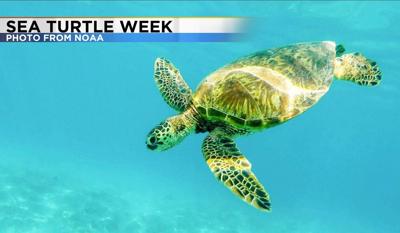

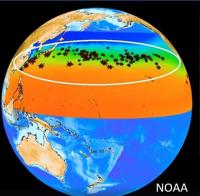
NOAA not only forecasts the weather but they also do a lot of marine and aquatic research. June 15th marks the start of sea turtle week and you can find a lot of information about sea turtles online. The week was implemented to help bring awareness to the endangerment of sea turtles and further the research to help them thrive. They live in tropical or subtropical climates. You can find them all over the world, including the Pacific and Atlantic Ocean. There are seven different species of sea turtles, and six of them can be found along the United States coastline. You can find the migration of Loggerhead sea turtles on NOAA Satellites. They tend to swim in temperate waters, where it’s not too hot or cold. They are born off the coast of Japan and travel 8,000 miles to Baja California to feed and grow. Sea turtles spend most of their lives in migration, but the females typically return to the beach to lay eggs. The males will return to the beach to breed as well. They will oftentimes swim a long ways to find food. Their swimming routes can range from hundreds to thousands of miles.

Leatherback sea turtles are very migratory and can travel 10,000 miles each year in search of food. Jelly fish are their food of choice. You can find them in the Atlantic Ocean along the east coast. This includes places like North and South Carolina, and Georgia. You can even find them along the Canadian coastline. You can also find them in the Pacific, in Southeast Asia. According to seaturtles.org, a sea turtle named Yoshi traveled 22,000 miles from Australia to east Africa and back. The image of the hatchlings below is from NOAA.

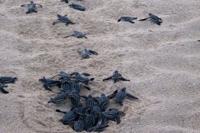
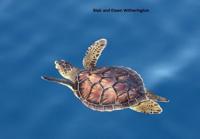
According to NOAA, the temperature of the nest has a big impact on determining the sex of the sea turtle. Their nest is made of sand. The cooler the sand the more likely the sea turtles will be male. Warmer sand leads to female sea turtles. Something in between can lead to a mix of male and female hatchlings. Interesting to note, sea turtles cannot hide in their shells. Instead they are great swimmers. Their flippers in the back are used for steering. Green sea turtles are green, because of what they eat. They mainly eat seagrass and algae.

You can read more about sea turtles by going to the following websites. That’s where the majority of this information came from.
https://www.fisheries.noaa.gov/feature-story/10-tremendous-turtle-facts