

UPDATE: Governor Steve Sisolak has now officially issued a proclamation announcing a special session to address redistricting. Sisolak waited to issue the proclamation until after the Veterans Day holiday when government offices were closed.
The session is scheduled to begin at 1 p.m. in Carson City.
---
Now that state lawmakers have had a chance to look at the data from the 2020 census, they have the obligation to redraw the state's district boundaries. That will begin, Friday, when lawmakers convene for the state's 33rd Special Session. Democrats released their proposed maps, Tuesday.
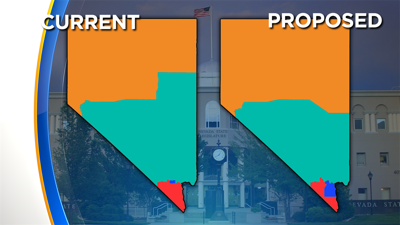
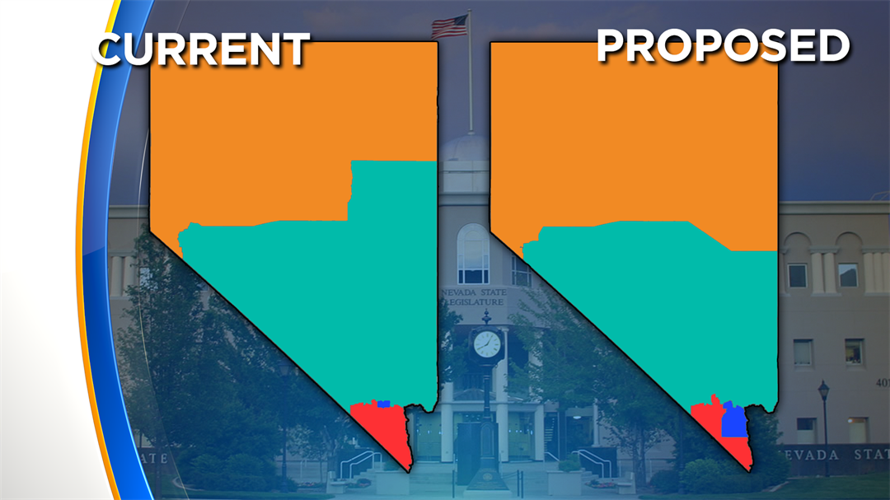
Their proposal would change all four of Nevada's congressional districts. CD2 is in northern Nevada, stretching from the California state line to the Utah state line. The map would change it, slightly, adding White Pine County and a larger portion of Lyon County to the house district. Rep. Mark Amodei, R-Nevada, represents CD2. If lawmakers approve the new boundary, republicans would remain as the dominant party in his district.
The changes in CD2 would cut into CD4, held by Rep. Steven Horsford, D-Nevada. That district stretches from southern rural Nevada to North Las Vegas. The proposed map would also move part of Las Vegas into CD4.
CD1 is in the heart of Las Vegas and includes The Strip. Rep. Dina Titus, D-Nevada represents the state's smallest geographical district. The proposed map would extend the district to the east, through Henderson and Boulder City, all the way to the Arizona border.
If that happens, it would cut into CD3, represented by Rep. Susie Lee, D-Nevada. That district would still represent southern and western Clark County.
The changes would add more republican voters to CD1 but it would remain a democratic stronghold. CD3 would move from more of a swing district to one with a higher percentage of democratic voters. CD4 is already very democratic and that would not change very much. Overall, the map would solidify the three southern districts as blue ones.
Democratic leaders say the maps are drawn to account for Nevada's population growth and diversity. They say it expands voting power to African Americans and Hispanics and increase opportunities for Asian Americans and Pacific Islanders.
In a joint statement, Assembly Speaker Jason Frierson, D-Las Vegas and Senate Majority Leader Nicole Cannizzaro, D-Las Vegas explained why they prefer the changes.
“Nevada’s population and demographics have changed rapidly and significantly in the last decade. The proposed maps for the Legislature and U.S. House districts reflect both our growing population and diversity. Throughout the state, we’ve proposed compact districts that keep local communities together, including maintaining representation for rural and northern Nevada and undoing the prior map’s splitting of tribal communities. Reflecting Nevada’s increasing racial and ethnic diversity, these maps strive to both protect and expand the voting power of African-American and Hispanic Nevadans while increasing opportunities for representation for Nevada’s emergent and growing AAPI population over the coming decade. We’d like to thank the public for their input during the Legislature’s interim committee process, and we look forward to a robust discussion of this proposal during the upcoming Special Session.”
The maps would have significant impacts in northern Nevada for both the Senate and Assembly. Two of the biggest shifts would be to Senate Districts 15 and 16. Senate District 16 is very conservative, including southern Washoe County and Carson City. The proposal would also add Storey County to the district, as well as a large section of west Reno that currently sits in District 15. If the plan goes through, Senate District 15 would shrink. It would change from a swing district to one with a much higher concentration of democrats.
It is a similar situation in the Assembly. District 26, representing southern Washoe County would expand into west Reno, almost all the way to Verdi. That would cut the majority of Assembly District 25 out, leaving a smaller district. Assembly District 25 leans republican but it would shift in the democrats' favor if the map is adopted.
If both are approved, it would mean the seats held by republicans Sen. Heidi Gansert and Assem. Jill Tolles could likely turn democratic in the next elections.
Democrats hold majorities in both houses and the governor's office, so there is little Republicans can do to stop its passage.