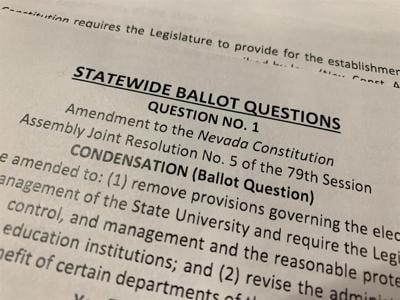
Nevada voters will receive their paper ballots in the coming days. Along with electing political leaders, they will decide on five statewide ballot questions. All of them would make changes to the state's Constitution.
"If something in NRS (Nevada Revised Statute) needs to be changed, the legislature can easily change that during a legislative session and it's a relatively quick process," Wayne Thorley, Deputy Secretary of State for Elections said. "But if something needs to be changed in the Nevada Constitution, it's a multi-year, multi-step process that isn't always easy to advance."
Question 1 would remove provisions relating to the election and duties of the Board of Regents. The board controls Nevada's state university system. If passed, it would give the legislature more authority to make various changes regarding the Board of Regents.
"The ballot question just would give the legislature the authority to do that if they wanted to," Thorley said. "The legislature would have to pass a bill in a future legislative session to do something like that."
Question 2 would change the Constitution by removing the provision that only recognizes marriage between a man and a woman. Voters effectively banned same-sex marriage by passing the constitutional amendment in the 2000 and 2002 elections. In 2015, the United States Supreme Court decision made same-sex marriage legal throughout the U.S. If voters approve Question 2, it will update the Constitution to reflect the country's law, treating same-sex and opposite-sex marriages the same. It would also allow religious organizations and members of clergy to refuse to officiate a wedding without facing legal challenges.
"There's already Supreme Court precedent on this and so obviously the current language in the Nevada Constitution that says marriage is only between a man and a woman is obviously not enforced right now," Thorley said.
Question 3 deals with the Board of Pardons, which consists of the governor, attorney general and the state's seven Supreme Court Justices. If passed, the Constitution would require the board to meet at least once per quarter. Currently, it meets twice per year. The governor's vote has more clout than the others.
"If the governor doesn't vote in favor of a pardon, then it doesn't go through, so it's essentially veto authority," Thorley said. "Even if eight of the members vote in favor of a pardon and the governor votes against it, then it doesn't go through."
Question 3 would remove that authority and the governor's vote would not have any more weight than the other eight votes.
Question 4 would take Nevada Revised Statute regarding voting rights, and put it in the constitution. They include the guarantee for eligible voters to receive and cast a ballot, have questions regarding voting procedures answered, vote without being intimidated, threatened or coerced, the ability to vote early or on Election Day, return a spoiled ballot for a replacement ballot, request assistance in voting if needed, receive an accurate sample ballot, receive instruction on voting equipment, have equal access to election systems without discrimination, have a uniform statewide standard for counting ballots, and to have complaints about elections and contests resolved fairly, accurately and efficiently.
"It really wouldn't change anything because we're already following everything that's in the Voter's Bill of Rights," Thorley said. "It would just enshrine it in the Constitution."
Question 5 is blank on the sample ballots. That is because the question did not qualify for this election. Since Question 6 passed in the 2018 election, it has to appear as Question 6 on the 2020 ballot, as well. That question would make a constitutional change to the state's renewable energy portfolio. It would require utility companies to adopt the new standard. At least 50% of the electricity sold would have to come from renewable sources by 2030. Voters passed the measure in 2018, before the legislature passed the same renewable energy portfolio standard in April, 2019.
"In 2019, the legislature, through a bill, put this renewable portfolio standard increase in law, so it already exists," Thorley said.
Some of the bills do come with a fiscal impact to the state. Thorley says it is important for voters to read their sample ballots and educate themselves on the questions so they can make an informed decision at the polls.