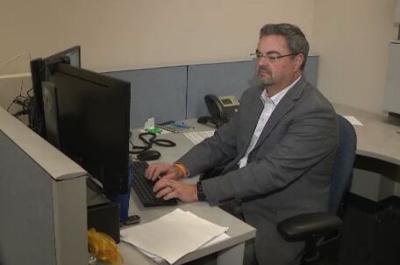


The Forensic Science Division of the Washoe County Sheriff's Office is studying the DNA of a local man. Chris Long was diagnosed with leukemia in 2014. The chemotherapy destroyed his bone marrow, so he received a bone marrow transplant in March, 2015.
"To be honest with you, I'm not sure I was going to be here," Long said. "So if I could help out any way, I wanted something positive to come out of this awful experience."
Long works in technology services for the sheriff's office. His colleague asked him if they could study his DNA following his transplant. It is the first time WCSO has done a study like this, and experts say this could be the first of its kind, period.
"They actually thought that this would be fascinating to study the DNA outcome of a bone marrow transplant with someone who was so well-known to this office," David Jackson, Supervising Criminalist & DNA Technical Leader for the WCSO Forensic Science Division said.
"It was pretty fun to be a part of, actually, because it's people I work with," Long said.
Long would put a few drops of his blood on a cotton ball every day and send it to the lab.
"They ran those through their machines and as time went on, each day you could see the DNA profile of me go down and my new one come up," Long said. "I had a new DNA profile in my blood by Day 20."
Bone marrow produces blood, so that explains why all of his blood has his donor's DNA. Researchers also learned that the DNA wasn't just in his blood. They found the second set of DNA in samples of his hair, saliva, tissue and other fluids.
"The analysts who were interpreting those results were fascinated by seeing how much of the donor was present and how much of Chris was present in different samples," Jackson said.
Long admits, having an extra set of DNA created a lot of questions. Those include which DNA would pass down to potential children in the future.
"That's been the fun 'What if?'" Long said. "We've done that quite a bit in our little story, too, here. The DNA would be me if I was to have kids but I don't want to have a kid, right now. I have two that are wonderful."
"I would be extremely surprised if they would be anything other than Chris' children walking around," Jackson said.
Long's donor lives in Germany. Long says he hasn't taken on any new genetic traits.
"You mean wanting more beer and brats? No, no I haven't," Long said.
He says the chemotherapy may have given him darker hair. Other than that, there aren't any DNA-related physical changes either.
"It's still me," Long said. "Even though I have two DNAs now, it's definitely still me that's here, and my personality, good or bad."
"The rest of Chris has a lot of his own DNA in it and the vast majority of Chris is Chris' DNA," Jackson said.
Long credits his donor for saving his life. His cancer is in remission and he says he is grateful for the extra time he has, following his treatment.
"Getting to stay a little longer on this planet, I've gotten to see my daughter get married," Long said. "I got to get married, myself. So there's pretty amazing things for that time period to be here."
Jackson says the research could be instrumental in future crime cases. There have been cases in other states that involved people leaving their donor's DNA at the crime scene. He says the testing provides fascinating genetic and forensic information that will allow them to better-understand certain situations. He says the information is valuable but it's not the best part of the study.
"The most important thing, even for us in this lab is to have seen Chris recover from this and to be alive, well, and kicking," Jackson said.
Long has communicated with his donor over the phone. He plans on traveling to Germany, this summer, to meet the man he credits for saving his life.
"He's a hero for me but for him, he's very mild-mannered," Long said.
The 51-year-old cannot be a donor because of the cancer but he encourages anyone else to consider being a donor. All it takes is a cheek swab to get into the registry.
"To be on a registry, to be a match, how important and how fun would that be that you know that you got to save somebody else's life?" Long said.
Long says donating bone marrow doesn't really cause any pain, saying it is similar to donating blood. Anyone interested in donating can head to bethematch.com