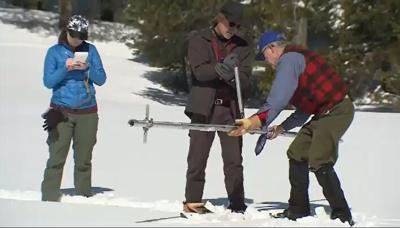
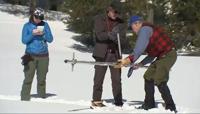
The California Department of Water Resources carried out manual measurements of the Sierra Nevada snowpack on Thursday.
Measurements at Phillips Station revealed a snow water equivalent (SWE) of 2.6 inches, 14 percent of the early-February average at Phillips as measured there since 1964. SWE is the depth of water that theoretically would result if the entire snowpack melted instantaneously.
“California experiences the most variable weather in the nation,” said DWR Director Karla Nemeth. “It’s vital that water conservation efforts remain consistent regardless of the year’s precipitation.”
More telling than a survey at a single location like Phillips are DWR’s electronic readings today from 103 stations scattered throughout the Sierra. Measurements indicate the SWE of the northern Sierra snowpack is 4.6 inches, 27 percent of the multi-decade average for today’s date. The central and southern Sierra readings are 5.8 inches (30 percent of average) and 3.8 inches (25 percent of average) respectively. Statewide, the snowpack’s SWE is 4.9 inches, or 27 percent of the Feb. 1 average.
“The snow survey today shows water content far below average for this time of year,” said Frank Gehrke, chief of the California Cooperative Snow Surveys Program who conducted today’s survey at Phillips. “Today’s measurements indicate an anemic snowpack to date, but there is still the possibility of a wet February and March.”
The snow in a good year supplies water to millions of Californians as it melts throughout the spring.
Department of Water Resources spokesman Doug Carlson says water officials are concerned. Carlson notes there are still two months in the rainy season.
Last year, near-record rains in Northern California snapped a five-year drought in the state. Gov. Jerry Brown declared the state's drought over less than a year ago, in April.
(The Associated Press, Department of Water Resources contributed to this report.)