


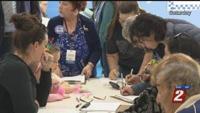


The Nevada caucuses are in the rearview mirror, with Bernie Sanders getting 47 percent of the votes. Democrats say the caucuses were successful, once again, but that voter turnout on Caucus Day was underwhelming. Of the 105,195 total voters, nearly 75,000 voted early. Some say that is a clear sign that Nevadans would rather have a primary election than a caucus.
"I think that big, huge turnout for the early caucus really proves that people want a primary," Sarah Mahler, Chair of the Democratic Party of Washoe County said. "They want a ballot. They don't want to come to an hour meeting."
Former Nevada senator Harry Reid was a driving force to make Nevada the "First in the West Caucus". Now he is promoting the idea of switching to a primary election.
"I believe we should make the process of selecting our nominee even more accessible," Reid said. "We've made it easier for people to register to vote here in Nevada in recent years and now we should make it easier for people to vote in the presidential contests. I believe it's time for the democratic party to move to primaries everywhere."
"I think Reid, in a sense, changing his mind from caucus to primary is very important," Eric Herzik, Professor of Political Science at the University of Nevada, Reno said. "That really kind of undercuts the whole caucus process."
Moving to a primary election would require the state legislature to approve it. That could be challenging because of additional costs.
"Elections are almost always run by states and that's a half-million dollars," Herzik said. "That's an estimate per party and this is a state that really doesn't like to spend much money on such things."
As for the 2020 results, Sanders is hoping his momentum will carry him into the South Carolina primary and Super Tuesday.
"He's got money, he's got organization because remember he ran four years ago and a lot of that's still in place," Herzik said. "That's going to be very important to him, and the centrist part of the democratic party, they've got to decide on who their person is going to be."
Joe Biden finished as the runner-up in Nevada, with 20 percent of the vote. Herzik says he needed a big showing in order to give a much-needed jolt to his campaign. Iowa and New Hampshire were disappointing for the former vice president. Money is always a factor in how a campaign proceeds.
"Biden was starting to experience that with poor performances," Herzik said. "I think he again is going to get that proverbial shot in the arm and we'll see how well he does in South Carolina."
Pete Buttigieg took 14 percent of the vote, with Elizabeth Warren finishing with 10 percent. Tom Steyer had 5 percent and Amy Klobuchar had 4 percent. Herzik says a poor showing in South Carolina or on Super Tuesday could signal the end of the Warren, Steyer and Klobuchar campaigns. He is surprised that Warren and Klobuchar did not do better in Nevada because of the gains women candidates have made in the Silver State.
"The top three finishes were two old white men and Pete Buttigieg, a young white man, and the women trailed poorly," Herzik said.
Sanders has cemented himself as the front-runner after the first three states. Still, a lot can change as more states vote.
"You hear in the media, 'Oh, decisive victory, overwhelming frontrunner,'' Herzik said. "I agree with that but he's still, his best showing was in Nevada and he got under 50 percent."
Now that the caucuses are over, the democratic party is turning its attention to the future.
"Making plans so that we can organize further and work on school board races, city council races, county commission races, congressional races," Mahler said. "Every vote matters."
The democratic county convention is set for April 18.
To look at the numbers from the Nevada caucuses, click on this link: https://nevadacaucusresults.com/