

In CBS’ summer series, "American Wonders," they’re exploring places that make America wonderful, from majestic natural landscapes to spectacular creations.
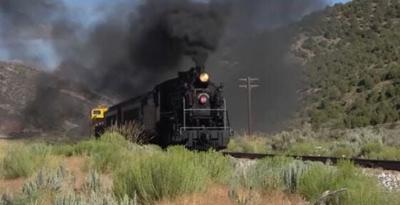
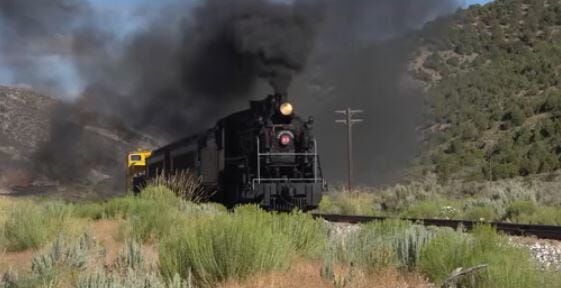
On Wednesday morning, they boarded a historic train bound for the remote Great Basin Desert near Ely.
Its passengers are not there to see sunny landscapes. They are focused on the views after dark.
CBS Sunday Morning correspondent Lee Cowan takes us for a ride on the Great Basin Star Train.
"Good morning from one of the least populated places in the country aboard one of the oldest operating railroads in the country. It's taking us deep into the high desert of Nevada where the only thing more scarce than people is light."
These tracks have been here for over 100 years and to this day, they're about the only manmade things you'll see way out here.
"If you leave Ely, there's a sign that says, next gas 164 miles. And they mean 164 miles,” says Mark Bassett of Nevada Northern Railway.
Bassett looks the part of a railroad manager and it's not for show.
"You wanna take a peek up front?”
“Man…Absolutely I'd love to..."
He's the president of the Historic Nevada Northern Railway out of Ely - a town built by this railroad - that's still chugging along.
"It's a long way from just about anywhere..." says Cowan.
Bassett adds, “And ya know, that is our strength and our weakness. If we were near Las Vegas right now it would have all been bulldozed down. But because of our remoteness, it was preserved."
These trains have been running ever since copper was discovered here. There's no ore to haul anymore - but the railroad does offer passengers -- something as black as coal.
"All aboard!!"
A night ride under the stars…
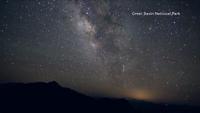
Just before sunset - it heads out for a three hour ride toward Great Basin National Park certified as one of the darkest regions in the lower 48 states. No lights are allowed.
Way up ahead is Park Ranger Charlie Reed - racing the sun to set up telescopes before the train arrives.
"You just kinda let the sky do the talking for ya. You don't have to do much for it because once you see it, you see it."
And what the Star Train passengers are about to see - still impresses even him.
"Does it ever get overwhelming out here?" asks Cowan.
"Well, I'll tell ya, the first time I came here. The first night I was outside my house and I looked up and I go, ‘uh oh!’" says Bassett.
"’Cause there was just so much?"
"I can't find my marker stars, I can't find any of the stars I used to use to navigate around because there was so many!"
A hundred or so years ago - a night sky like this was oddly ordinary. But now more than a third of the planet's population can't see the Milky Way with the naked eye all because our world is increasingly polluted with light.
"The more darkness we lose, we're going to lose the universe, quite literally, and all the secrets that that universe holds,” says Bassett.
As the train creeps to a stop in the dark, passengers are greeted by the eerie glow of red lanterns instead.
"What do you see for me young man?"
And then, it happens...
"Whoa!”
Bassett agrees, “Yep. Kid whoa!"
The view of our universe...
"Whoa. Whoa! Oh my gosh."
The way most have never seen it.
"Oh wow...really?” asks a mother.
Bassett agrees, “mm, hmm.”
Mom replies, “Oh my goodness."
Another mother, Suzanne Tatis says, “This is incredible! I've never seen the Milky Way in my life...."
Tatis and her 10-year old nephew James were spellbound.
"I couldn't believe my eyes,” says Tatis.
“I've only seen things like that in pictures!" says James.
Sue Middendorf came all the way from St. Louis for this view.
"It's just beautiful. It really is. It makes you feel so small.”
They look like fireflies gathered around a campfire. But soon it's time to board the Star Train and head back - an excursion into the dark - that for a while anyway sheds a little light on our place in the universe.
“The race to save all of this darkness is gaining steam but time is of the essence. As modern lighting becomes more powerful, and cost effective - even remote places like this one - may one day be in danger of living under what some call an eternal twilight,” says Cowan.
For more information on the Great Basin Star Train, click here: https://nnry.com/pages/StarTrain.php
(CBS News)