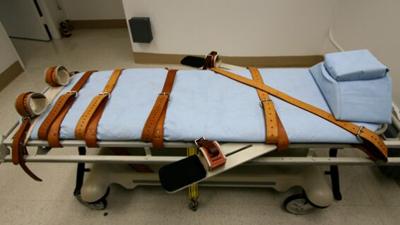
Nebraska has carried out its first execution since 1997 with the lethal injection of Carey Dean Moore, who fatally shot two cab drivers almost four decades ago.
Moore was executed Tuesday with a combination of four drugs that had never been used before in an execution in the United States, including the powerful opioid fentanyl. The execution also marked the first lethal injection in Nebraska.
Moore was condemned to die for the 1979 shooting deaths of two Omaha cab drivers, Maynard Helgeland and Reuel Van Ness Jr., and is one of the nation's longest-serving death row inmates.
His death comes about three years after Nebraska lawmakers abolished the death penalty, only to have it reinstated the following year through a ballot initiative partially financed by Republican Gov. Pete Ricketts.
A German pharmaceutical company tried to block the execution by alleging the state had illicitly obtained at least one of its drugs. A federal judge refused to stall the execution.
Meanwhile, two drugmakers are asking the Nevada Supreme Court to let a state court judge hear arguments before justices hear an appeal about whether the state can use their products for an execution.
State attorneys, meanwhile, point to a federal judge's decision last Friday in Nebraska not to block Moore's execution based on what they call "copy-cat" arguments.
A trio of Monday court filings left Nevada's highest court to decide whether how to proceed with a prisons effort to reschedule the twice-postponed lethal injection of a twice-convicted killer using three drugs never before tried in any state.
Drugmaker Alvogen says the state is misleading justices about drug expiration dates to get the court to rush a decision toward what the company calls misuse of its product.
(Copyright 2018 The Associated Press. All rights reserved. This material may not be published, broadcast, rewritten or redistributed.