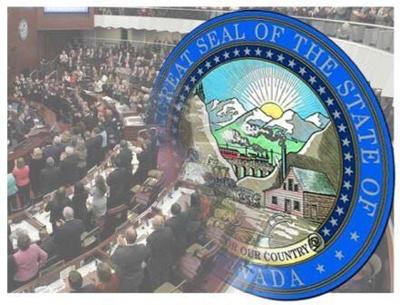
After about four months, the five big budget bills are being presented in the Nevada Senate and Assembly. Lawmakers will determine which programs to fund, and how to spend nearly $8.1 billion over the next two years. The largest budget is public education, which requires nearly half of the state's revenue. The others bills include appropriations, authorization, capital improvements and payroll.
"Once we get the education passed, then we can pass our bill that pays state employees, we can pass our bill that funds state government, we can pas all of that," Assem. Teresa Benitez-Thompson, D-Reno said.
The budget bills are presented in the final week of the session, allowing smaller policy bills to pass. Many of those policies are a part of the overall budget, like a possible excise tax on recreational marijuana sales that could produce nearly $70 million. Lawmakers also look at bills that require state funding, including educational programs like STEM and English Language Learning. Capital projects including, a new DMV in south Reno, a new engineering building at the University of Nevada, a northern Nevada veterans home, and Project Neon in southern Nevada all have to pass as part of the overall budget.
"It's much like breaking down an engine and then rebuilding it into the engine and then rebuilding it into the engine that you think you need it to be," Assem. Paul Anderson, R-Las Vegas said.
"An extraordinary amount of work," Sen. Aaron Ford, D-Las Vegas said. "We've put in 115 days or so, already, of important work to ensure that we have policies and priorities set for our state, based on what we heard from our constituents."
The budget is closely aligned with Governor Brian Sandoval's proposed budget, but like most sessions, the legislature is making a few adjustments.
"We really believe there had to be more money in the mental health," Benitez-Thompson said. "We've parted ways in a couple of places but for the most part, it is a consensus budget."
"There's still some moving pieces," Sen. Ben Kieckhefer, R-Reno said. "I think we're close. I'm hopeful that we're going to be able to reach some sort of an agreement on a broader package to get Education Savings Accounts funded, and if we do that, I think that we're gonna be in a happy place."
Lawmakers started looking at the budget, a couple of weeks before the session even started. They spent the first two weeks of the session going through pre-session hearings. Since then, the work has all built up to this point.
"It's a long process," Kieckhefer said. "It's very detailed. The hours are countless but it culminates in the introduction of the big budget bills that is happening here, today, and we'll hopefully get ready to pass them."
While the Senate Finance and Assembly Ways and Means Committees have had a steady dose of budget talks, its members also have the other legislation to deal with.
"I think, arguably, the hardest-working committee here is the Finance Committee because they not only have to deal with the finance issues, but also policy issues that have financial impacts," Ford said.
Lawmakers say more than 95 percent of the budget has been bipartisan, but that still leaves a little room for disagreements and compromise.
"It really comes down to the 3, 4, 5 percent of the budget that we haggle over, back and forth," Anderson said. "Some of those are policy, ideologically driven."
"At least in the Assembly Ways and Means Committee, the votes to move budgets, as are, out of committee have been unanimous and I think that that's promising," Benitez-Thompson said.
Time is of the essence. Four of the budget bills cannot be acted on until the education bill passes. That is expected to happen within the next few days. The Appropriations Bill has to be available to the public and lawmakers for 24 hours before it can get voted on, adding transparency to the process.