


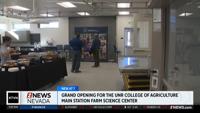

Friday marked the grand opening of the UNR College of Agriculture Main Station Farm Science Center.
Bill Payne, the Dean of the College of Agriculture, Biotechnology, and Natural Resources, says this facility advances their important missions in research and teaching, and outreach through extension.
"With the extension for now, it looks like they'll be focusing on things like horticulture, 4H, master gardeners, and perhaps their meat science program alike," he said.
Payne says this facility will help our economy in Nevada and the livelihoods of Nevadans, including providing jobs.
"Well, meat, for one thing, and it's an important part of the economy," he said. "It generates jobs and income."
He tells us there aren't that many places that process meat in Nevada. And the Wolf Pack Meats facility is organically run and is USDA inspected for approval.
"For meat sciences and animal sciences, again, there's a research component to that, and there's a teaching component to students and academics, if you will. And there's an outreach component for cattle, for beef, for lamb, and increasingly we'll probably do it with pork as well."
The facility can handle 48 students at a time, and to start, they're piloting one course, which they wish to increase to several courses in animal science, meat science, veterinary science, and wildlife science.
The grand opening itself included presentations and tours of the facility.
Payne wants to emphasize that they've never had a facility like this before, and this one has been in the works for 10 years.
He says having this building gives them the capability to teach more efficiently.
"Before, if you had someone out here, they would do that lab part of a course, but there are no classrooms, so they have to go back on campus for the class part," he said. "If they had a lab component, there are no labs here, so they would have to go back to the campus for the lab. And something more basic than that, there are no restrooms out here, so if the student had to use the restroom, they had to walk to Wolf Pack Meats. So, all of that would interrupt teaching and make it more inefficient."
Payne says they also want to share the opportunity with the Department of Agriculture and the Department of Wildlife for use in the future as well.