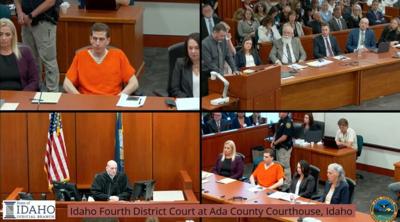
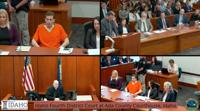

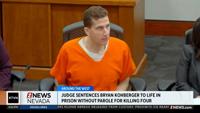











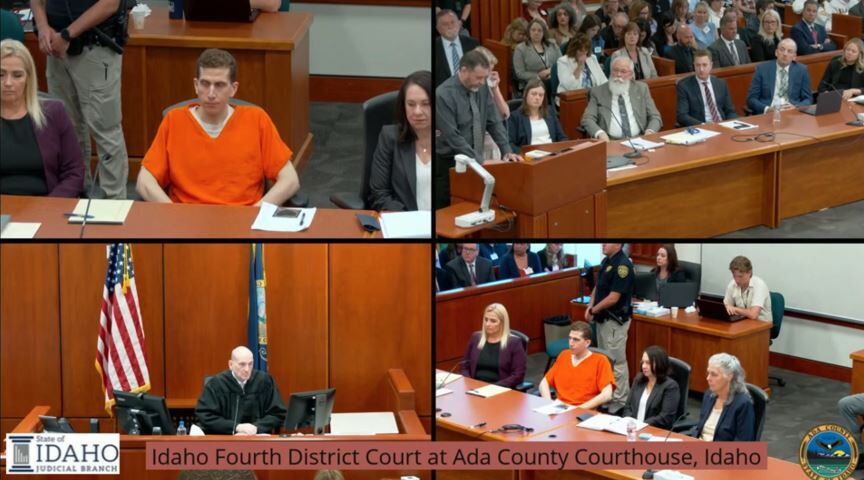
A surviving roommate from the 2022 college student murders in Idaho provided an impact statement during Bryan Kohberger's sentencing on Wednesday.
Bethany Funke, provided a statement that a friend read on her behalf in the courtroom.
She described the day her four friends died as “the worst day of my life, and I know it always will be.”
Court documents previously stated Funke lived in Washoe County. She had filed a motion in Washoe County Second Judicial District Court to dismiss a subpoena to testify in Kohberger's defense, but that motion was quashed.
His attorneys said her testimony was vital and could clear their client.
“I was getting flooded with death threats and hateful messages from people who do not know me at all,” Funke’s statement read.
Kohberger’s gaze remained locked on the friend reading Funke’s statement.
For a year after the killings, Funke said she slept in her parents’ rooms.
Funke said she still checks her room every night before bed.
“The fear never really leaves,” her statement read.“For a long time, I could barely get out of bed. But one day I realized, I have to live for them,” it read.
Funke was inside an off-campus rental home on November 13th when Kohberger stabbed to death 21-year-old Madison Mogen, 21-year-old Kaylee Goncalves, 20-year-old Xana Kernodle and Kernodle's boyfriend, 20-year-old Ethan Chapin.
Kohberger remained stoic and expressionless as the testimony went on.
Police initially had no suspects, and the killings terrified the normally quiet community in the small, western Idaho city of Moscow. Some students at both universities left mid-semester, taking the rest of their classes online because they felt unsafe.
Police used genetic genealogy to identify Kohberger as a possible suspect, and accessed cellphone data to pinpoint his movements the night of the killings. Online shopping records showed Kohberger had purchased a military-style knife months earlier, along with a sheath like the one at the home.
Kohberger was arrested in Pennsylvania about six weeks after the killings. He initially stood silent when asked to enter a plea, so a judge entered a “not guilty” plea on his behalf.
Both the investigation and the court case drew widespread attention. Discussion groups proliferated online, members eagerly sharing their theories and questions about the case. Some self-styled armchair web-sleuths pointed fingers at innocent people simply because they knew the victims or lived in the same town. Misinformation spread, piling additional distress on the already-traumatized community.
As the criminal case unfolded, Latah County Prosecutor Bill Thompson announced that he would seek the death penalty if Kohberger was convicted. The court-defense team, led by attorney Anne Taylor, challenged the validity of the DNA evidence, unsuccessfully pushed to get theories about possible “alternate perpetrators” admitted in court, and repeatedly asked the judge to take the death penalty off of the table.
But those efforts largely failed, and the evidence against Kohberger was strong. With an August trial looming, Kohberger reached a plea deal. Prosecutors agreed to drop their efforts to get a death sentence in exchange for Kohberger's guilty plea to four counts of first-degree murder and one count of burglary. Both sides agreed to a proposed sentence of four consecutive life sentences without parole, plus an additional 10 years for the burglary charge. Kohberger also waived his right to appeal any issues in the case.
His mother quietly wept at times as the victims’ parents described their grief. She sobbed briefly when Maddie Mogen’s grandmother said her heart goes out to the other victims’ families, as well as to Kohberger’s family.
His father did not attend the sentencing hearing, though he was present when Kohberger pleaded guilty earlier this month.
Judge Steven Hippler then ordered Kohberger to serve four life sentences without parole. He was also given a 10-year sentence for burglary and assessed $270,000 in fines and civil penalties.
Second surviving roommate, Dylan Mortenson, who was in house during the killings, testified next
She tearfully described panic attacks that force her to relive the trauma of that night relentlessly throughout the years that followed the murders.
“I was too terrified to close my eyes, terrified that if I blinked, someone might be there. I made escape plans everywhere I went,” Mortenson said.
Kohberher’s head bobbed slightly as she spoke. Mortenson ended her testimony with an emphasis on her determination to heal.
“He may have shattered parts of me but I’m still putting myself back together piece by piece,” Mortenson said.
(The Associated Press contributed to this report.)