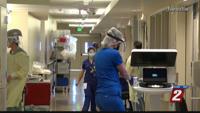




The Omicron surge is affecting hospitals throughout Nevada. Some are dealing with staffing issues because of illness or exposure. Others are dealing with high capacity numbers. The Nevada Hospital Association says Washoe County is averaging 214 COVID-19 hospitalizations over seven days, ending January 25. Renown Health's CEO says his hospitals have challenges but that there are plenty of beds available.
"What we're seeing is lots of backlog because people are showing up in the emergency departments, some of the wait times are a little bit longer but we have hospital beds," Tony Slonim, CEO of Renown Health said. "We can care for people."
One of the reasons why is because patients are responding to Omicron differently than previous variants. Slonim says Omicron is an outpatient condition, where people do not usually require long stays in the hospital.
"The hospitalization rates are usually very, very low for Omicron unless, this is why context is important, unless you're unvaccinated," Slonim said.
In Washoe County, 72% of the eligible population has at least one dose of the vaccine. He says boosters and antiviral agents are also helping.
"Compared to where we were, we are in a whole different place in combating this virus," Slonim said.
He says in the early days of the pandemic, there were not a lot of options available for care of patients. He says hospital staff could only provide supportive care.
"All we could do for people was support their organs as they failed," Slonim said.
Medical staff was also dealing with a shortage of equipment and PPE in 2020.
"Early on in the pandemic, we were talking about enough ventilators, we were talking about enough gowns and gloves, we were talking about, wow, did we have enough equipment to care for people," Slonim said.
Slonim says the pandemic is proving that health care is a local phenomenon. The issues that are happening in Reno and Sparks might not be the same ones that other states are dealing with.
Staffing is an issue that many hospitals are dealing with, either because of illness or exposure to the virus. Renown does have a mandatory vaccination policy in place for its employees.
"I think it's important to do," Slonim said. "It's certainly stood the test of time, so if you come to Renown, you get cared for by vaccinated employees which is very important."
One of the biggest challenges for Renown is hiring staff. Slonim says it is hard to find young medical workers who are looking to start their careers as the cost of living rises. Medical staff has been dealing with the pandemic for nearly two years and the virus is having an impact on them.
"Every health care worker knows that when they come to the hospital, they might get sick but for the very first time, they've seen themselves in the eyes of the patients and families that they serve," Slonim said. "That could be them in their bed."
Despite the progress, Slonim is concerned about children under the age of five who cannot get vaccinated yet.
"As a pediatrician and pediatric intensive care doctor, I continue to worry about that," Slonim said. "Two clinical trials that were going on failed to demonstrate adequate results to demonstrate the efficacy of the vaccine and they've had to start again."
Slonim says Renown is expanding and upgrading its facilities with a futuristic view of the handling of logistics and health care. It opened the Renown Transfer Operations Center in August. He says it is similar to an air traffic control tower.
"We know on a continuous minute-by-minute basis where patients are, who's in the emergency room, what diagnosis they have, where there's a bed available," Slonim said. "If someone's out in a rural hospital and needs transportation, directly in that transfer center is a REMSA dispatch who can get us a helicopter."
Renown has had telehealth for about a decade. That is an option for locals and people who live in rural areas who do not want to drive into Reno. Despite that option, he says demand is on the decline.
"For some, even though virtual visits are available, they would rather come to the doctor's office and see their doctor or nurse, there in person," Slonim said.
The CEO says data appears to show that Washoe County has reached its peak in the Omicron surge and that we could see cases drop in the next couple of weeks. Despite all we have learned about the virus, there is still a lot to know about long-term issues related to COVID-19.
"Not only the long hauler implications," Slonim said. "What are some of the long-term chronic conditions we're going to see by virtue of having had the virus?"