



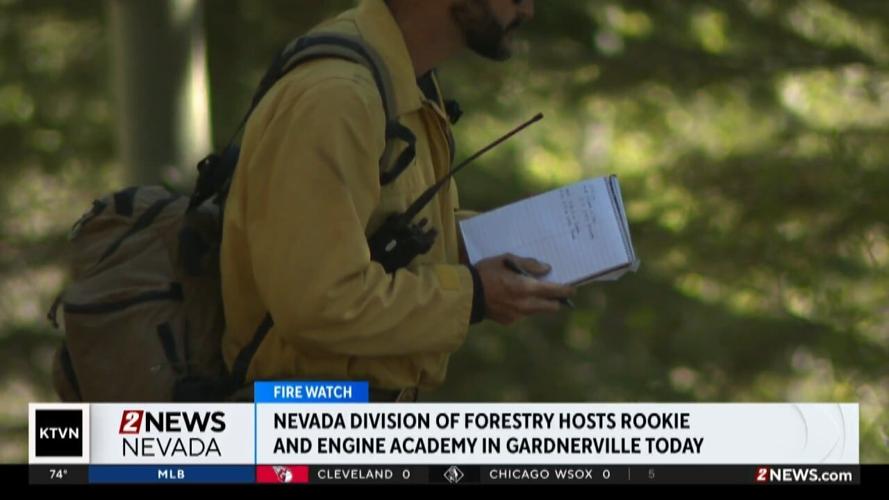
Future firefighters were put to the test through a simulated fire training.
The Nevada Division of Forestry (NDF) hosted multiple different agencies such as the Bureau of Land Management, North Lake Tahoe Fire Protection District, Mt. Charleston, and the United States Forest Service.
This academy is split into two: rookie and engine.
The academies are weeklong courses that provide both classroom and field work.
The NDF has hosted this academy since 2015.
The Rookie Academy had 34 participants and the Engine Academy had 12.
The Engine Academy prepares wildland firefighters to handle engines and working the hose.
The Rookie Academy involves learning how to use fire tools and constructing fire lines.
The academies started on Sunday, May 5, and Friday, May 10, is when both of them came together.
It was the last and final test to see if they have what it takes to fight fires.
"Really, today is just a culmination of everything we've been working on throughout the week. From learning how to cut different line, to learning how we run fire lines, and a little bit of everything," said Hailie Jones, Academy Participant.
The drill starts with trucks arriving to the scene to assess the situation.
Then, the Engine Academy trainees grab the hose and start walking down the line.
Once the line is laid down, it's time to start spraying.
After the area is watered down, it's time for the Rookie Academy students to be hand crews and create fire lines by digging out and using the chainsaw to break things up.
"When we're done, it essentially looks like a hiking trail," said Brian Esch, Assistant Supervisor of the NDF Attack Crew. "We're removing all burnable material down to bare mineral soil to deprive the fire of fuel and the opportunity to cross those containment and control lines."
The NDF wants to make this situation as close as they can to an actual wildfire so they can be prepared and teach the most important lessons.
"The teamwork and the communications is the keys to the success. Being able to communicate hazards," Esch said, "communicate needs, communicate issues. It helps keep everyone safe on the fire line."
Some of the participants said they love pushing their limits.
"I think it's gone pretty good," Jones said. "I mean, it was a little rough at the beginning just hiking up. But a lot of just embrace the suck and it's become a lot of fun."
They say during the academy, the hardest thing for these firefighters to overcome is the thing between their ears.
"Finding that mental grit and breaking through those mental barriers," Esch said. "The mind will want to give up way before the body does, and so we are pushing them past those limits they think they have."
Getting this training together does not happen overnight.
"It's a lot of logistical support and we have a great team with the Division of Forestry. And it takes months, sometimes half a year, to coordinate this collectively across all agencies," said Eric Antle, Deputy Administrator of NDF.
Some instructors say they are doing great work.
"I couldn't be more proud," Esch said. "From the beginning until now, the comradery that they've shown, the teamwork. They're really molding into a cohesive unit, and I think that'll serve them very well when they get out in the field and practice it for real."
While they say this training and getting future firefighters ready for the event that a wildfire was to happen, they say there's a lot you can do to also help them out, such as creating defensible space and having an evacuation plan.