A team of students from the University of Nevada, Reno's Mackay School placed second in the first annual American-Made Carbon Management Collegiate Competition.
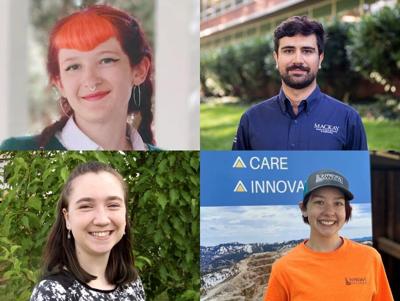
The team "Biggest Little Lithium" were made up of three undergraduate students Alexia Carver, Trista McLaughlin and Ash Thompson, and one graduate student, Kamal Mousavi. Their mentor for the competition was Department of Mining and Metallurgical Engineering Professor Ehsan Vahidi.
“I want to express my immense pride in our team's achievements and their dedication to making a positive impact on carbon management practices,” Vahidi said.
The competition, hosted by the Department of Energy’s (DOE) Office of Fossil Energy and Carbon Management, challenged students to propose regional carbon networks that would annually transport at least one million metric tons of carbon dioxide from industrial sources to locations that can use or permanently sequester CO2.
The top three teams will present their winning proposals at the DOE's annual Carbon Management Research Project Review Meeting this August in Pittsburgh, Pennsylvania.
“[The meeting] provides an excellent opportunity for the team to present their winning proposal and to network with carbon management professionals,” Vahidi said.
In addition to attending the conference, the team earned an $8,000 prize that the students will split among themselves.
Carver, the team captain, will be using the prize money to pay for travel to the conference in August and to finance her proposed research on bio-mining in the fall semester.
“Our team is the next generation of metallurgists, geologists, and environmentalists, so the strategies in this project will be vital for creating more sustainable mining technology as we enter the workforce—especially in the lithium sector,” Carver said.
Biggest Little Lithium’s submission turned CO2 into magnesium carbonate through modern chemical engineering. Carbon capture will reduce the environmental footprint of the Thacker Pass lithium mine in Nevada.
“By addressing the carbon emissions associated with the mining process, our team aimed to contribute to sustainable practices in the industry,” Vahidi said.
(University of Nevada, Reno)