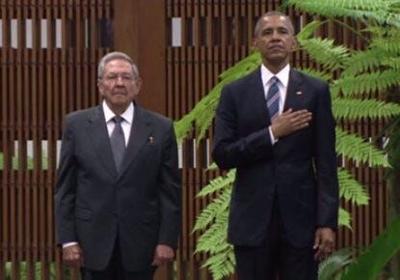
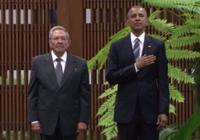
President Barack Obama says he and Cuban President Raul Castro had a "frank and candid conversation" on human rights and democracy, and are making progress in tearing down barriers between the two nations.
In extended remarks after the first private meeting between the leaders, Obama declared it a "new day" in relations between the U.S. and Cuba.
The president noted the two nations have "very serious differences," particularly on areas regarding freedom of speech, assembly and religious liberty. But Obama says he believes the two governments are capable of having a "constructive dialogue."
Obama noted success in increasing travel between the nations, increased trade and tourism. He says he's working to ease the path for joint corporate ventures and hiring more Cubans in the U.S.
Obama sought to reassure Cubans wary of the return of U.S. engagement. He says: "Cuba's destiny will not be decided by the United States or any other nation. ... The future of Cuba will be decided by Cubans not by anybody else."
Castro also called on President Obama to lift even more restrictions on Cuba.
He's also urging the return of land used for the U.S. naval base at Guantanamo Bay.
Castro says in a statement after Monday's meeting with the U.S. president that he welcomes changes by Obama to allow commercial flights to resume and changes in the area of telecommunications, for example. But he says an economic blockade that remains in place is the "most important obstacle" to Cuba's economic development and the well-being of the Cuban people.
Castro says he recognizes that Obama wants the blockade lifted entirely, but that Congress has refused to go along.
And - Agriculture Secretary Tom Vilsack announced that the United States and Cuba will share agricultural research and ideas, a move designed to help U.S. farmers better understand the Cuban market.
U.S. farmers are eager to step up access to Cuban markets. Agricultural exports to Cuba have fallen to their lowest levels since 2002, making the U.S. Cuba's fourth-largest supplier behind the European Union, Brazil and Argentina.
Vilsack is in Cuba as part of President Obama's visit to the island. Vilsack has signed a memorandum of understanding with Cuba's agricultural minister establishing how the two nations will share research.
The various activities researchers will undertake include testing recipes and specific products used by Cubans with the goal of increasing product development and acceptance. They will also study students' eating practices to help ensure they're getting adequate nutrition.
(Copyright 2016 The Associated Press. All rights reserved. This material may not be published, broadcast, rewritten or redistributed.