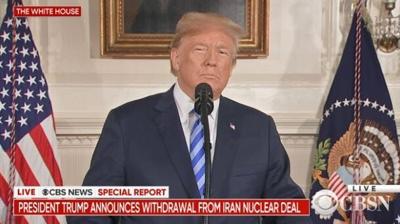
President Donald Trump says the United States is withdrawing from the Iran nuclear deal, which he is calling "defective at its core."
President Trump on Tuesday signed a presidential memorandum withdrawing from the 2015 agreement and he is planning to reinstall sanctions on the Iranian regime. He says in an address to the nation that he will be reinstituting the highest level of sanctions and warning any country not to help the Iranian government.
President Trump says America "will not be held hostage to nuclear blackmail" and will not allow "a regime that chants 'Death to America'" to get access to nuclear weapons.
The president says he made the decision after consulting with U.S. allies.
"Today, we have definitive proof that this Iranian promise was a lie,” President Trump says. "The fact is, this was a horrible one-sided deal that should have never, ever been made. It didn't bring calm. It didn't bring peace, and it never will."
President Trump says that if he allowed the deal to stand, there would soon be a nuclear arms race.
He also says a constructive deal could easily have been struck at the time, but it wasn't.
He is calling Iran a "regime of great terror."
And he says that "no action taken by the regime has been more dangerous than its pursuit of nuclear weapons and the means of delivering them."
In response, Iran's president says there's a "short time" to negotiate with the countries remaining in the nuclear deal, warning his country could start enriching uranium more than ever in the coming weeks.
President Hassan Rouhani made the statement immediately after President Trump said he was pulling the U.S. out of the nuclear deal.
Rouhani spoke live on Iranian state television. He says he will be sending Foreign Minister Mohammad Javad Zarif to countries remaining in the accord.
He says, "I have ordered Iran's atomic organization that whenever it is needed, we will start enriching uranium more than before." He says Iran would start this "in the next weeks."
Israel's prime minister called President Trump's decision a "historic move." He says leaving the Iran deal unchanged would be "a recipe for disaster, a disaster for our region, a disaster for the peace of the world."
Benjamin Netanyahu is a leading critic of the deal, saying it did not contain sufficient safeguards to prevent Iran from reaching nuclear-weapons capability or address Iran's other activities across the region.
He says Iran's aggression has grown since the deal, especially in Syria, where he says it is "trying to establish military bases to attack Israel."
Earlier, Israel's military said forces were on high alert and ordered bomb shelters open in the Golan Heights after spotting "irregular activity of Iranian forces in Syria
President Trump's decision deals a profound blow to some of America's closest allies - including Britain, France and Germany, who joined the U.S. only three years ago to sign the deal.
French President Emmanuel Macron vigorously supports the 2015 nuclear deal and tried to persuade President Trump to stay committed to it during a visit to Washington last month. Macron suggested there could be a way to move toward a new agreement that would address Trump's concerns as well as Iran's ballistic missile program and involvement in Middle East conflicts.
France played an important role in negotiating the deal, holding an especially tough line against Iran's nuclear activities. After the announcement, Macron tweeted, "France, Germany, and the UK regret the U.S. decision to leave the JCPOA. The nuclear non-proliferation regime is at stake."
The agreement required Iran to curb its nuclear enrichment program in exchange for relief from international sanctions.
Iran has denied ever seeking nuclear weapons.
Senator Dean Heller (R-NV) released this statement:
“The Iran deal was never good for America or our friends in the Middle East. This agreement has done nothing to stop Iran from acquiring a nuclear weapon or promote peace – in fact, it has done just the opposite,” said Heller. “Iran has been emboldened since President Barack Obama signed the Joint Comprehensive Plan of Action three years ago. In the face of this agreement, Iran has conducted ballistic missile tests, harassed U.S. naval ships in the Middle East, and helped prop up the murderous Assad regime in Syria. Members of Iran’s parliament have shouted ‘death to America’ and its Supreme Leader Ayatollah Ali Khamenei has said ‘Israel will not exist in 25 years.’”
Heller continued, “Clearly, Iran is not a trusted partner in America’s foreign policy goals. The agreement, which handed Tehran billions of dollars to help bolster its military and spread terror around the world, represented a volcano waiting to erupt. Make no mistake, Iran has been preparing for when the agreement was set to expire in 2025, and that’s why leaving this agreement and pursuing additional sanctions is the right choice.”
Congresswoman Jacky Rosen (D-NV) released the following statement:
“As a Member of the House Armed Services Committee, I’ve heard from military and intelligence experts about the dangers of withdrawing from the JCPOA without evidence of a material breach,” said Rosen. “After the JCPOA was agreed to, it should have been robustly enforced - not used as a political football. We need to hold Iran accountable in every way we can, and we cannot allow Iran to restart its nuclear program. Unfortunately, backing out of this agreement means undermining our international alliances, jeopardizing our national security, and re-opening Iran’s path to developing a nuclear weapon.”
Rep. Dina Titus (D-NV) released the following statement:
“Today Trump needlessly manufactured a crisis by breaking our commitments under the Iran nuclear deal,” said Congresswoman Titus, a member of the House Foreign Affairs Committee. “Instead of working with our allies to strengthen and extend the JCPOA, Trump has violated our commitment to the agreement and given Iran a free pass to resume its nuclear weapons program. Trump’s action is reckless and destructive and damages American credibility around the world at a time when he is also pursuing negotiations with North Korea on denuclearization.
“Rather than meeting our obligations under the agreement and holding Iran accountable, we are creating confusion, jeopardizing our allies, and giving Iran justification for reneging on its nuclear deal commitments. This is a major diplomatic mistake. Why would anyone trust us to keep our word in the future?”
(The Associated Press, CBS News contributed to this report.)
There are few issues more important to the security of the US than the potential spread of nuclear weapons or the potential for even more destructive war in the Middle East. Today’s decision to put the JCPOA at risk is a serious mistake. My full statement: https://t.co/4oTdXESbxe
— Barack Obama (@BarackObama) May 8, 2018
President Trump announces the U.S. will withdraw from the Iran nuclear deal: "It is clear to me we cannot prevent an Iranian nuclear bomb under the decaying and rotten structure of the current agreement. The Iran deal is defective at its core." https://t.co/LdFkRt50G9 pic.twitter.com/Ije8kPBezP
— CBS News (@CBSNews) May 8, 2018
"In theory, the so-called Iran deal was supposed to protect the United States and our allies from the lunacy of an Iranian nuclear bomb," President Trump says https://t.co/LdFkRt50G9 pic.twitter.com/DjAuF8O6UL
— CBS News (@CBSNews) May 8, 2018
France, Germany, and the UK regret the U.S. decision to leave the JCPOA. The nuclear non-proliferation regime is at stake.
— Emmanuel Macron (@EmmanuelMacron) May 8, 2018