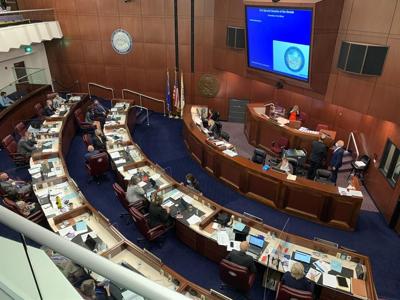
The Assembly is continuing its discussions on how to cut $1.2 billion from the state budget. The largest bill is AB3, which makes cuts to essentially every government agency in Nevada.
"We're cutting government and services at a time when we need them and so we need to make sure that we do it right and do it fair," Assem. Tom Roberts, R-Las Vegas said.
The largest chunk of the budget includes education and health care. Those make up nearly 84 percent of the state's General Fund spending. Nearly half of the budget cuts could come from those two areas.
"We've been taking input from the public, from the other members, listening to folks, trying to figure out where the biggest concerns are," Assem. Maggie Carlton, D-Las Vegas said. "If we can find new revenue, where can we actually make some changes?"
Carlton says making the steep cuts is a balancing act. Part of the puzzle includes spending that the federal government matches. So lawmakers are prioritizing some funding over others.
"If I can put 5 million bucks on the table and get 25 million from the federal government to provide services to Nevadans, that's where I want to put the money, so that we get more services back," Carlton said.
Republicans say it is critical for the legislature to balance the budget without raising taxes, since Nevada's economy is already struggling.
"Private businesses are suffering, families in our state are suffering and it's like, okay, who do you go to to put more of a burden during this time?" Roberts said.
Wednesday's Assembly session included a walk-through of the bill, but more changes could still happen before it votes on the bill.
"Remember, it takes us over 120 days to draft an appropriations bill," Carlton said. "In less than a week, we are in essence, rewriting that whole bill. So it's a complicated exercise."
Meanwhile, the senate spent most of the day working behind the scenes. SB3 is the only bill left that originated in the senate. It would require mining companies to temporarily pay their Net Proceeds on Minerals Tax, one year in advance.
"It doesn't change the way that mining pays taxes," Sen. Yvanna Cancela, D-Las Vegas said. "It just speeds up the process. So it should have a negative affect on those counties."
The tax is money the mining industry would have to pay anyway. Cancela says it just means the state would have access to that money earlier, and that it could add about $50 million dollars to the budget.
"The dollars won't get us out of the hole that we're in but they do help ensure that we're able to save some of the progress that are needed by our most vulnerable Nevadans," Cancela said.
Some lawmakers say the bill is a bad idea because it forces mines to pay the taxes in advance, when they may not have the money.
"My biggest concern is that we're singling out one industry and forcing them to pay a tax a year in advance on production that has not even occurred," Sen. Ira Hansen, R-Sparks said.
Hansen says larger mining companies can probably handle the early tax payments but that smaller companies might have to borrow the money in order to pay the state. Mines could also face fines if they're projections are less than 90 percent of their production at the end of the year.
"It's not easy to generate capital to keep these mines going and this again is going to reduce their capital flows and their ability to expand their mines and employ people in my rural communities," Hansen said.
SB3 also includes the movement of money from DMV registration taxes. Currently, 75 percent of that money goes to the Highway Fund and 25 percent goes to the General Budget. This would change the allocation to 50 percent to each one.
The Assembly is also working on AB1, which includes furloughs and pay cuts for state workers.